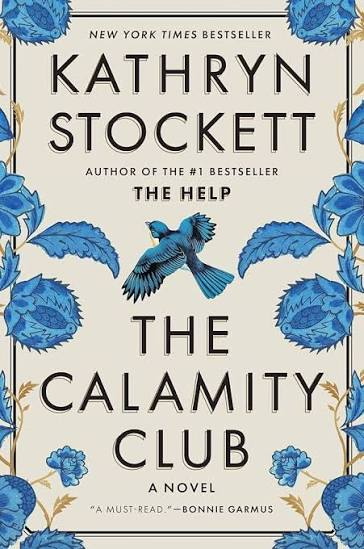
The Calamity Club by Kathryn Stockett

Birdie: It’s early 1930’s, and the Great Depression has hit Mississippi quite hard. Birdie considers herself lucky that she has a job, tedious and underpaid as it is. She has pretty much resigned herself to her single life, living at home with her Mama even as her younger sister has already flown the coup and gotten herself married, informing the family only after the fact. When circumstances become financially dire for Birdie and her Mama, she is encouraged to visit her now wealthier sister to ask for a loan. When she finds her sister and sees the reality of her life there, Birdie finds life can be challenging in ways she’d never dreamed of.

Meg: Being eleven years old at an orphanage during the Depression is hard, but never as hard as when the head of the establishment, the “esteemed” Garnett Pittman, just seems to have it out for you. Having been deserted by her mother two years prior, she continues to have dreams about her mother returning, which her best friend insists she must let go. But since she’s been exiled to a dreary, windowless room to herself all day, leaving only for meals and sleep, she can hardly be expected not to fantasize about her Mama. What else does she have to do? It is only when a new volunteer comes to work on the books for the orphanage and shows her a bit of kindness that she imagines she may have a future other than what Garnett has planned for her.

This is an incredibly beautiful story about women, their limited choices, and the lengths to which people will go for those they love. Written by the author of The Help, this novel is animated by the vernacular, the color, the beauty and the darkness of the South in the 1930’s. I listened to this on audiobook and found it utterly absorbing and entertaining, enjoying the lovely accents, rich characters and wonderfully snarky dialogue. As each of the histories of the main characters are gradually revealed, there is also a sense of horror at the evil inclinations of some and the victimization of many. Women at the time were particularly vulnerable, and those few with power did not always use that power for good.

But we root for these two characters – and many others – as we come to know their kindness, their sensitivity, and their complexity. And as the plot thickens, and takes unexpected curves, we find we worry for their safety and keep turning pages (or listening attentively) just to ensure we learn their fates. There is a great deal of suspense, of caring and of sadness – as there is in real life.

It’s been awhile since I’ve designated a book a “MUST READ,” but The Calamity Club absolutely is one! Whether you read or listen, I guarantee you will be taken in and love it!

The Four Winds by Kristin Hannah

Although she’s been told she’s worth nothing her whole life, Elsa still dreams of a world in which she might accomplish something worthwhile. Being 25 and unmarried in the early 1930’s is a pretty clear indication that chances are slim that you will be leaving your family home at all. No, you’ll likely be under the thumb of your overbearing, critical mother and father your whole life. Unless you take action. Unless you do something drastic – like maybe buy that bolt of bold, red silk and sew yourself that beautiful, lavish dress and just sneak out for that night on the town and pretend you’re like everyone else– to hell with what they say. Be brave, her doting grandfather used to say to her. Well, she just might. Little does Elsa know that being brave will have to carry her through all of what comes thereafter, as she takes each next step, wanted or not.

In The Four Winds, Kristin Hannah has written what will inevitably come to be known as a great American novel, a sort of Grapes of Wrath narrated through the voice of a woman. We are lured inside the head and the heart of our heroine, Elsa, a modest, resourceful, and hard-working woman, bitterly rejected by her own family. She easily earns our sympathy, as she gradually gains her own strength, visualizing her own purpose. We feel love when she is finally loved and we shed tears when she is hurt, and we applaud her as she overcomes one arduous obstacle after another.

This is also a story of a dark era in our history. The Dust Bowl crisis during the Great Depression was a tragic consequence of the prolonged drought that occurred during the 1930’s, and layered onto the economic crisis of the Depression, it could not have come at a worse time. Scorched farmlands bankrupted thousands, and, lured by advertisements for jobs, too many fled west and found only steeper poverty and absent resources. The narrative starkly highlights the failure of our country to adequately provide for those who were left with nothing.  This left those who were more fortunate, empowered by their vigilante groups, to demonstrate only anger and hatred toward these folks who were starving for work, starving to have the opportunity to help themselves. 

I love that the women here are strong characters. Elsa grows into a strong character as she comes to know herself. Her daughter, Loreda, is born strong – rebellious, with a righteous anger that is sometimes misdirected but always idealistic. And there is Elsa’s mother-in-law, Rose, with her quieter strength – a woman who is fiercely loyal, uncomplaining, and who has the softest heart and is present when it matters. These are beautiful characters who will likely stay with you long after you finish turning the pages of this novel.

This story will singe a hole in your heart, but it will also fill it with admiration for the souls who fought for others, to raise up the unfortunate. It also reminds us how frequently history does repeat itself and how important it is to learn from the past.

A definite MUST READ – and a future classic.