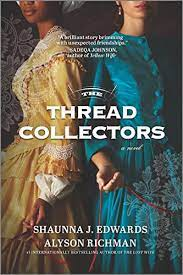
The Thread Collectors by Shaunna J Edwards and Alyson Richman

When Stella and William say a passionate farewell at the beginning of this story, they have no idea if they will ever reunite. William is an enslaved Black man in the South, escaping his master at the outset of the Civil War, and Stella is an equally indentured Black woman who technically is free but is “kept” by a White man for his “pleasure.” All William has is his flute and his magically musical ear, but this wins him a place by the side of his newfound friend, Jacob. Likewise, Jacob, a Jewish New Yorker, who has signed up on the side of the Union, with the dream of fighting to end slavery, has also bid goodbye to his true love, Lily. He also has no idea if he’ll be able to return to her, fearing the worst as he moves closer and closer to the front. All he can hope for is that her continued correspondence and her love for him will help him through his arduous fight.

This narrative was apparently based on true characters in the history of the two authors’ families. Each of them is writing about the marginalization and, particularly in the case of the Black men who fought for the Union, dehumanization, experienced by these soldiers. And how relevant is this story now? With the rise of antisemitism and racism that is rampant in this country – and worldwide – it is both tragically and unsurprisingly, unchanged. Both Jacob and William experience the feeling of being treated as less-than, socially, financially (William is paid less than his White counterparts in spite of doing their scut work), and in terms of supplies, food and healthcare. Moreover, I feel that many of us can, sadly, relate to the schism in Jacob’s family, as he finds that his brother sides with the South and defends the vile institution of slavery, while Jacob and Lily fight for abolition.

As a novel in itself, however, I feel it is just ok. While it tells an important story, and there are some gritty and heart-rending scenes, it is mostly on the predictable side and just a bit corny. A few coincidences are just too perfect and a few situations turn out just too well to believe.

On the whole, however, it is a worthy read and one can learn quite a bit about this slice of history, from a more insider, less glamorized perspective.

The Consequences of Fear by Jacqueline Winspear

Maisie Dobbs is pulled in once again to a new case, when she learns of a young boy, a messenger in London during WWII, who is witness to a brutal murder. The problem is that those around her seem to not believe this young boy, who, to her, seems not only trustworthy, but also in danger himself and worthy of protection. So even while she is caught up in clandestine work for the British defense against the Axis forces herself, she cannot resist delving into the details of this case as well, even when it might put her and those around her in potential danger.

I should probably have read this series in the order they were written, because there are recurring characters and continuing story lines. Nevertheless, each book is a stand-alone novel and a story worth reading and I have found each that I have read engrossing, entertaining, and endearing. Each character is written with charm and wit and the relationships between the characters are quite beautiful. For example, the working relationship that has developed between Maisie and her assistant detective, Billy, has grown into a collegial and respectful,  and yet tender and caring one. They are a formidable yet wholesome team. 

This series is a fun mix of historical fiction and mystery/suspense that always achieves just the right grittiness and never disappoints.   

The Heaven and Earth Grocery Store by James McBride

Moshe never imagined himself worthy of such a catch as Chona, the beautiful daughter of the owner of the grocery store who, because of her limp, was reading in the back more than she was working in her father’s store. He was actually more focused on getting himself settled, out of debt, financing his theater, which he managed to do by inviting in the Negroes of the community of Chicken Hill as well as the Jews (a radical move in the early 1930’s in Pottstown, PA, where the KKK had its annual parade down the town center). But he managed to win her heart with his openness and his respect for her intelligence and free spirit. And they were happy together, their only disagreement being about where they should live, he believing they should move out of town, as most of their fellow Jews had, and she believing they were already home, with their Negro neighbors who had always been their friends and saw no reason for them to leave. Of course, he gave in to her, as he always had, knowing that their closest friends were right there with them, the Black couple who worked with them day in and day out, Nate and Addie. When this couple approached them with a request for a favor, Chona immediately said yes, setting them up for trouble they had no idea they were in for.

James McBride has a magical way of creating the most colorful characters who are flawed in the most gorgeous way possible. Chona, with her limp, her seizures, and her mysterious illnesses, is the most beloved character in all of Pottstown. Nate, with his inner turmoil and fury, has a quiet and kind exterior that earns him deep respect (and, yes, fear) from all who encounter him. And the bonds that form between these beautiful, sometimes comical, sometimes tragic characters, often of different races, are borne of longstanding histories of common suffering and oppression. By necessity, yes, but also by loyalty and friendship as well.

Herein also lies a commentary on how the mentally ill were treated at the time, which is to say that they were not treated at all, but rather locked away from society, and at the mercy of generally untrained, unkind, and unsupervised caretakers. Utter chaos reigned and heaven help anyone who was brought to one of these facilities. Moreover, it was a random path to finding oneself there, as “diagnosis” was random, not scientific at all. One could be physically ill, deaf, speak a foreign language, or just have a different view of life and find oneself declared mentally ill. And if you were not mentally ill when you first got there, the “treatment” there would ensure that you would be after a short time.

This is a powerful story, there are powerful commentaries on life in the US as non-white folks, and it is well worth the read. Don’t miss it!


The Covenant of Water by Abraham Verghese

Mariamma is only 12 when she’s told she is to be married off to an older widow. There is nothing to be done, as this is her fate, just as it was for her own mother and those who came before her, in her home in southern India at the start of the 1900’s. She is, in truth, more worried for her dear mother, who herself has been widowed and is now at the mercy of her father’s brother, who perceives her more as a burden than as family. But Mariamma knows she is loved, knows how to love, and this serves her well. She enters her new home with an open heart and embarks upon a journey that brings her both great joys and deep sorrows.

This is a gorgeous family saga that enriches the reader with a deeper understanding of not only Indian culture, but of a bit of the unrest that ensued after the liberation of India from British rule. We immediately bond to Mariamma and her life becomes part of our own. When the plot shifts to focus on Digby, a young Scottish physician who comes to India on a quest to get practical surgical experience, we find ourselves adopting him as well. The characters and their stories are authentic, vulnerable, and gritty and we can’t help but get swept up in their struggles and their joys.

One of my favorite characters here is Mariamma’s husband, who is referred to as Big Appachen. He is a man of very few words, but his actions speak for themselves. He is generous beyond words – he rewards those who are loyal to him (and sometimes those who are not) with land grants and opportunities – and tries to overlook the traditional caste system that divides the people who work for him. While he does not express what he feels verbally, he shows it in the most important ways – through his protectiveness, his generosity, and his kindness. (I know I could learn from this, being one of many words.)

I loved this book. I believe these characters will live on with me for a very long time.

Give yourself the gift of reading it – you will not be disappointed! For sure, a MUST READ!


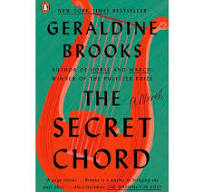
The Secret Chord by Geraldine Brooks

Taken by brute force after the slaughter of his family, Natan, a young boy of ten years, unwittingly reveals his gift as a prophet of the Name. Recognizing his value, David, the leader of the rebel forces being hunted by King Shaul, brings Natan into the fold and keeps him forever by his side as trusted advisor and friend. And it is Natan who narrates this story of David, as he witnesses David gathering strength, power and ultimately the throne over the motley tribes of Israel, revealing David’s wisdom and his failings, his humanity and his vulnerability.

This fictionized version of history is as poetic as it is violent, with scenes of love and of war, scenes of fanfare and of mutiny. The writing is beautiful, with imagery that builds the story in the mind’s eye with crystal clarity. We are given a window into the character of David himself and it is multi-layered and complex. David is a leader, as we all know – but he is deeply flawed, human. He is charismatic, brilliant, musically gifted, and sensitive, and yet his vanity, violence, and blind spots for certain people in his life create his vulnerabilities. Natan becomes his conscience, his guide, and often the only one who will speak truth to him, even as he fears the possible repercussions of his words.

Yet another excellent novel by Geraldine Brooks – though not for the feint of heart. She brings these biblical characters to life and we come to feel what life might have been like at that time for the unstable royalty that was so short-lived in that land.

City of Girls by Elizabeth Gilbert

Vivian was never exactly interested in following in the path her nuclear family had laid out for her: school, perhaps a temporary job before she settled down to a marriage, and of course motherhood, thereby maintaining the social status comparable to that which she was born into, in her upstate NY, 1940’s, upscale community. So, when, at the age of 19, she failed out of Vassar after essentially never having attended any classes — clearly flouting this path — she was shipped down to Manhattan to live with her equally unconventional Aunt Peg. Here in the heart of the theater district (well, almost), Vivian found her freedom – the ability to explore the city, the ability to express herself in ways she could never have imagined, and also the ability to make mistakes she would gradually learn and grow from.

This novel is just as entertaining as the theater world itself, opening the curtain to both the comedy and tragedy of NYC in wartime 1940’s, the challenges of managing a theater production with all its moving parts, and underneath, the struggle of a young girl finding out who she really is in the midst of all this frenetic drama. As Vivian falls in love with the city and with her newfound theater family, we find ourselves falling in love with each of the characters. Vivian’s Aunt Peg, with all her vulnerabilities, is as generous and forgiving as anyone might be and teaches us the beauty of living in this way. Her “secretary,” Olive, a no-nonsense, teetotaler, who never hesitates to remind everyone how little money they all have, demonstrates loyalty in the most understated and compassionate ways. Peg and Olive become both the liberators and the anchors for Vivian.

The voice of the narration is also quite clever. The story is told by Vivian to Angela, and we only discover late in the game who Angela actually is. We hear her name periodically as the story unfolds, and this reminds us that we are being told a story from Vivian’s perspective to someone in particular with a particular goal. It is a confession of sorts, but without the remorse or regret a confession has because there is no sin, no misdeed. It is just an honest telling. And we love Vivian for her living her life without apology and without regret, as she has lived, for most of her life, an honest life.

This is a beautiful book of historical fiction – highly recommend this!

The Magnificent Lives of Marjorie Post by Allison Pataki

Marjorie Post, daughter of the famous CW Post ,had a modest beginning. We meet her as she begins her trip to Battle Creek, MI, in the family’s quest to heal her ailing father. He’d been wasting from a severe depression and sought out the famed Dr. Kellog, to see if he might benefit from the diet, exercise, and fresh air treatment he was known to prescribe. Little did they know that the one who would heal him and be the most inspiring for him was their family’s hostess, who rented the rooms to Marjorie and her mother while CW received his tasteless treatments. She cooked him healthful meals and nursed him with her spiritual inspirations, enabling his soul to be revived. What lay ahead, both for CW and for Marjorie, was a growth of spirit and of creativity that would open their worlds to both unimaginable successes and tragic failures.

This historical fiction is based on the truly impressive and accomplished life of Marjorie Post, daughter of the famed CW Post, inventor of the breakfast cereal – Grape Nuts being the first! – and the founder of the General Foods Empire. Marjorie grew the business, creatively adding their many other types of foods and related products, finding ways in which to make a mother’s life more convenient, and hoping to provide nutritious foods to more families at a reasonable cost. She had an acute business acumen and would not give up on an idea once it worked its way into her brain, and she risked her reputation, her business, even her personal relationships when she knew she was onto something that might help others.

For this she paid a price, most often in her personal life, as many took advantage of her generous nature. Whether it was in her relationships- and she collected a few – or the press, who delighted in using her personal scandals as fodder for their gossip columns. But her true joy was her daughters, her work, and her volunteerism, which she threw herself into with gusto.

A little tidbit I learned from this also: she is the one who built the 126-roomed Mar-a-Lago. I have to confess, I had a hard time being excited to hear about the planning of its layout and the decoration of its rooms knowing who would be its future occupant, but I swallowed it in the name of history and fiction. I went with the spirit of the book. Marjorie was generous with her money, gave to many causes and was all in when times were rough for her country (unlike its current occupant) She was inspiring, actually (again, unlike the current occupant!).

If you are interested in historical fiction and want to know more about this very impressive woman, take a few days to peruse this novel. You’ll meet a lot of famous people, suffer a few heartbreaks along with her, and bask in her successes along with her as well.


The Glass Ocean by Beatriz Williams, Lauren Willig, and Karen White

Sarah has hit rock bottom. After her first success with Small Potatoes, she has hit a wall and has not found the next big idea for a similar blockbuster book. And the pressure is on, as she has her mother’s care to consider. What will she do?

Meanwhile, dialing back to 1915, we meet both Caroline and Tess. Caroline, graceful and talented, is married to a self-made man whom she loves but is finding to be unwilling to let her into his private and distracting business life. While they host a pre-departure soiree in their mansion in midtown Manhattan for all those leaving the next day on the luxurious Lusitania, she reunites with an old crush and wonders what will happen when they are all together on this journey. And Tess, from a different background altogether, cannot seem to stay in the shadows where she is seeking to acquire what she needs to deliver on her final undertaking for her sister and their “business.”. She just needs to do this one last job before she also boards the Lusitania and starts off in her new identity, her new life. The tensions are high for all of them as rumors of German U-boats abound… but surely the British naval ships will protect them, won’t they?

As you can easily see from my repeated Beatriz Williams book reviews, I love her writing. Full stop. She creates powerful female characters with depth, strong will, and acerbic wit – and this collaboration is no exception. All three main characters are like magnets, drawing us near, holding us to their stories, and keeping us wanting more.

The plot is written by these three characters’ stories as well. Each presents a different perspective which carries the story to the next level, taking it through its twists and turns, helping to build the suspense. And even though we all know the Lusitania is attacked by a German U-boat and sunk, the suspense is not jeopardized but rather enhanced by this; that is, we do not know exactly when or how it will happen, who will survive it, and how it will impact our characters in the end.

This is yet another wonderful historical fiction novel by one of my very favorite authors and her colleagues – I absolutely recommend it!

The Guernsey Saga by Diana Bachmann

This trilogy begins with the joining together of the Ozanne and Gaudion families, traditional families living on the small island of Guernsey off the coast of England beginning in the early 1930’s. They are joined by the marriage of Sarah to Greg, with Sarah reluctantly giving up living with her boisterous family to join Greg’s elderly parents in his more staid household. Fortunately, her older sister, Ethel, often comes round to cheer her. Sarah and Ethel had shared a room as well as a close bond and a sense of humor, which often got them into uncontrolled giggles during their family meals. The trilogy follows the family through three generations: during the Nazi occupation of the island, during cultural upheaval of the 1960’s, and during the financial fluctuations of the 1970’s.

This is a warm and beautiful family saga, with moments of solemn strife alternating with times of tearful tenderness. While the circumstances of the family are unique, the underlying issues are timeless. Adolescent rebellion, inter-generational miscommunication, internal loyalty battles, spousal mistreatment, dishonesty – all issues that we can all relate to no matter the era, no matter the culture. The characters are relatable as well: the self-doubting, tongue-biting mother; the critical and self-righteous husband; the quiet and studious son – there are so many likable (and unlikable) and colorful characters who we come to know over the three books so well and over their years that we are sad to leave them when the third book ends.

The writing here is also poignant and effective. We really come to know the characters so intimately that we feel their pain, their stress. When they are starving because of the limited food on the island during the Nazi occupation, we feel their hunger. When we learn about Sue’s loneliness during the war, when she’s been sent with her school to Wales for safety, we yearn as she does for the love of family. And when Stephanie rages against her mother, we feel the deep cut of hurt that Sue feels.

Living in a small town where everyone knows everything about you and your family – your history, accomplishments and failures – might be challenging. But I can’t help wondering what a trip to seaside Guernsey would be like -it sounds magical!


Circling the Sun by Paula McLain

Even at a young age, Beryl is willful and daring, which is probably the thing that keeps her steady, even as her mother deserts both her and her father, taking only her fine clothing and Beryl’s younger brother back to England. But Beryl was built for Kenya, for the open sky and the wild fauna, and her heart seems to heal as she is cared for by the local tribespeople and her father, such as he can. As she grows and becomes a natural horse trainer, she holds on to her innate independence, which casts her as both unique and odd, admired and scorned, loved and hated, invited to the party and gossiped about afterwards. Nevertheless, in her own way, she succeeded in making a name for herself, breaking barriers and changing norms.

In fact, this is a novel based on the true life of Beryl Markham, a woman who was a pioneer both in horse training and in aviation during the 1920’s and 1930’s, mostly in Kenya. She fought against sexism on many fronts, merely yearning for independence, to make her own way. At the same time, she succumbed to love for a man who had the same yearning for freedom, one who could not be tied to anyone. While she understood this at her core, it also brought her as much heartache as it did joy.

What is also unique about the novel is the gorgeous depictions of Kenya. There are only sparse references to the colonization of the country and its impact on the tribes – it might have benefitted the story to have more. But there are rich descriptions of the wildlife, the terrain, and the flora. I have never been but I would love to, particularly after reading about it here.

It’s a beautiful story and an impactful one. Once again, we see how a woman is rendered nearly powerless but manages to overcome the obstacles thrown her way. It is inspiring and hopeful in so many ways.