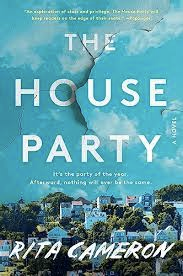
The House Party by Rita Cameron

Aah, the year is finally winding down for the students at New Falls High School and they are ready to party.  Will and his older brother Trip are definitely on board, but when they arrive with the beer, they are a bit surprised to find that this one is taking place at the fancy new house being built on the river. Well, Will deserves to party just like the rest of them, doesn’t he? He’s worked so hard to get to where he is – a senior, with a well-deserved acceptance to Princeton and a scholarship from the town’s board. Little does he know how out of control this particular party would get – and how it would impact the course of his life, his family’s, and the lives of the couple building this new home.

This novel, set in a small suburb of Philadelphia just prior to the economic crash of 2008, is a well-crafted indictment of the “lawnmower parent,” the parent who smooths the way for their child at all cost. (Usually wealthy and/or privileged, these parents don’t allow their children to suffer any consequences of their actions; hence these children do not learn that they are to be held accountable for what they do.) We hear the story from the perspective of the teenagers – who are mostly of age (18 or older) – but we also hear it from the perspective of the homeowners who are building their dream house – which, of course, gets demolished. We feel for the children who, yes, have made a mistake and their futures are at risk. But we also understand that they need to be held accountable and restitution made for the damage they’ve created.

We also feel for those who are more vulnerable, those with less means. Even in a town that prides itself on the peaceful blending of the working class and the “newer money” families at the high school, there is a clear division between who the DA’s office deems disposable and who is protected, who can be targeted and whose reputation must be preserved. Meanwhile, we see how quickly this status can change, with the onset of the troubles of the couple who are building the home. No one is immune to this possibility.

This is such an engaging read with a social commentary so important, I believe, that I would consider this a MUST READ. I’d be curious to hear what others think!


Say the Right Thing by Kenji Yoshino and David Glasgow

There have been so many excellent (and some not-so-excellent) books written about racism, how to be an antiracist, and diversity and inclusion. Many of us have been in trainings, whether through work or community opportunities, to inspire and instill in us an understanding of structural racism and power dynamics. But even while we may have come to have a basic understanding of these concepts, few books lay out the tools of how to be an ally and/or to stay in a growth mindset in such a practical, non-judgmental and concrete way as Yoshino and Glasgow have done here in Say the Right Thing. In addition, the advice here is generalizable to all non-dominant groups – not just racial groups. And, as they point out, almost every one of us may find ourselves in a situation where we are the culprits engaging in non-inclusive behavior, and later be either at the receiving end of it or as an ally. Through vivid vignettes, humble stories about themselves, and relevant research concepts, we are given advice on how to handle each of these scenarios.

What I appreciate most about the writing here is the humility with which the authors share this essential information. While they are both highly qualified to be writing this book – both are attorneys, educators, and come from non-dominant communities – they also acknowledge their own privileges and that we all may fall into spaces of privilege relative to others. Their focus, therefore, is not how to understand the position of the “other” but rather to understand our own obligation to react appropriately when issues arise. We are obligated to check our own reaction if we are challenged by someone about an act we may commit – even unwittingly – and to keep ourselves open to learning how to do better always. They also acknowledge how hard this can be, as almost always our unwitting acts are not with evil intent. But of course, good intent does not preclude harm.

It is an easy read, full of concrete suggestions, and utterly important in this moment of divisiveness and fracture – when communication is essential and understanding is the key to bringing this country back together.

Another MUST READ, I believe.

Special Topics in Calamity Physics by Marisha Pessl

Since her mother’s death years ago, Blue has been traveling around with her father, a professor of history and politics, measuring time in semesters, and in random locations throughout the US. While her father is certainly attentive — indoctrinating her with his philosophical theories, drilling her in vocabulary, and encouraging her reading of every book ever written (which she quotes throughout the narrative) – he also seems to attract women to himself as magnets attract shards of steel. When they actually commit to a single, fancier house in a small town in N Carolina and to a single school for the entirety of Blue’s senior year, Blue cannot believe her luck. And much to her surprise, she actually becomes visible to her peers after being invisible for most of her life, being chosen by one of the teachers, Hannah Schneider, to join a small, tightly knit clique of admiring, rebel students who spend Sunday afternoons with her in her home. This invitation will change Blue’s life path forever.

This is one of the most unique novels I’ve read in quite awhile. The writing is outstanding. Pessl creates characters who are simultaneously mean yet sympathetic, powerful yet vulnerable, familiar yet mysterious. The narrative is replete with sardonic humor and an encyclopedic breadth of cultural and political references, which Blue annotates as she relays her experience. There are also enough unexpected turns that even when you believe you know, you actually have no idea what is coming. It is also the kind of story that you continue to ponder and puzzle over long after the last page is turned (my favorite part…).

I could say so much more, but I don’t want to give anything away. I feel it would take away from your discovering these characters and this intricate plot for yourself. So I won’t.

I will only say it’s a MUST READ – just for the fun of it!!


Year Of Wonders by Geraldine Brooks

Anna can only imagine what it must be like to have the weight of the whole village upon his shoulders, as does Michael Mompellion, the village vicar. It is he who has carried the prayers, the hopes and dreams as well as the trauma of those who have lived – and died – among them. That is not to say that Anna has not been there as well. Anna, and Michael’s wife, Elinor, who as the time passed, became more of friend and less of an employer to Anna, have nursed so many of the villagers, caring for them and comforting them. But what they saw together, what they experienced, no one should ever have to. And so Anna understands his wrath toward the wealthy family the Bradfords, on their return, after deserting their village when so many relied upon them. What happened after that, however, she did not expect…

Here is another hard and yet utterly addictive novel by Geraldine Brooks. The time is the 1660’s, in a tiny village in the UK where the Plague has been carried into the town by a kindly and unwitting messenger. After he takes ill and gives warning to burn all of his possessions – a warning that goes unheeded – the disease creeps into the homes of those around him and ravages the village over time.

What we see, however, is all too familiar. We see it bring out the best in some and the worst in others. We see a 1600’s version of misinformation and we see people grasping at untruths because they are desperate and have a deep-seated need to blame someone or something for their misery and pain.

Many may feel that this is too soon after our own plague, but it does feel different. To me it highlights our privilege of scientific advancement and evidence-based medicine. It highlights the knowledge we’ve gained over these centuries and the ability to study a new pathogen with logic and with precision- to develop treatments and vaccines to protect ourselves and to prevent the worst outcomes at lightening speed. On the other hand, and most tragically, our most recent plague has also brought to light the continued distrust and misinformation that runs rampant in our communities as well. The cynical and damaging anti-vaccine misinformation that has been circulated by darker forces in our country via social media and Fox News has stirred just as much unrest and backlash toward legitimate science as did the believers in the witches and magical incantations of the 1600’s. (And just like in those times, the motivation is the same: money.)

This is a powerful and elegantly written novel, deeply researched and exquisitely presented. If you have the capacity to read it, it is absolutely worthwhile. I’d call it a MUST READ, if you are able.


Horse by Geraldine Brooks

Jarret, an enslaved Black boy in the South, may be small, but he knows his horses and he knows how their lineage matters. This is what his father has taught him and what he recites with him each night as they sit on their porch on warm, Southern nights. When Jarret witnesses the birth of his newest beauty, Darley, he and the horse form a bond that will last for decades.

Fast forward to 2019, and we meet Jess, who has found herself working at the Smithsonian, far from her home in Australia. From a young age, Jess has been fascinated with the bone structures of animals, and she is now working to prepare them for analysis and study at one of the world’s most venerable American institutions. It is here where her path crosses with Theo, an art history graduate student at Georgetown, writing his thesis and researching articles for a magazine for the same institution. When their research brings them together, they find that there is more that they share than their interest in a horse that lived a very long time ago.

This is one of those novels that you yearn to keep reading to know what will happen, but you also don’t want to keep reading because you don’t want it to end.

There is so much that has been packed into this extensively-researched novel that there is so much to unpack. First, I learned so much about horses and horse racing. Not familiar with this world, I learned about the breeding of the horses, how their treatment and mistreatment has evolved, and how important their anatomy is to how effectively they can race. There is a love of animals that is expressed throughout this novel that I share quite deeply.

The story also depicts racism, as it existed during the 1800’s, when slavery was still legal in this country, and as it still very much exists today. We see how Jarret is treated as an enslaved young man, which varies depending on who has ownership of him (and what they believe they can get from him). We cannot help but compare him to how Theo, our graduate student at Georgetown, is treated in current day, where he experiences almost daily comments, micro-aggressions (which are often not very “micro” at all). Both men are highly intelligent, experts in their fields, and are respected – but over and over again, encounter obstacles purely because of the color of their skin.

But don’t be fooled – the learning is all so easy. It comes through a beautiful story, with beloved characters and a heartfelt and moving plot. And even if you’ve never been on a horse or never watched one race, you will fall in love with Lexington (nee Darley)!

This is 100% a MUST READ! Loved it!

Tomorrow and Tomorrow and Tomorrow by Gabrielle Zevin

Sadie is full of resentment, even though she can’t admit it. She’s given up her summer to be with her sister – and that’s ok, I mean, her sister is battling cancer, for god’s sake. She’s doing her best to be out of everyone’s way, when she comes upon a quiet boy named Sam, who, it appears, likes to game as much as she does. In fact, as his nurse has observed, Sadie is the first person Sam has actually spoken to since his horrible accident and his multiple foot surgeries. When the nurse requests that Sadie come back and game with him some more, trying to pry him further out of his shell, she encourages the development of a friendship that will go through many lives – almost like those of the characters they become in their games.

I am not a gamer, in any way, shape or form. But I loved this book and found it relatable on all of its levels. While gaming is the language the characters use to communicate, we sense their vastly deeper connection to each other, the love they feel. We also experience their pain and understand how they rely on gaming to escape this pain – to dive into worlds that are dreamlike, fantastical and utterly distracting in order to just get through. As they create games for others, they use this knowledge to create alternate realities for others to escape as well.

I also love how the plot unfolds. It surprises, interrupts, detours, and restarts – almost as if in a game itself. Because of this, it captures our imagination but also feels as real as one’s own heartbeat. It is simultaneously lyrical and tactile. The characters are both idyllic and deeply flawed.

I believe this is a MUST READ – a creative, imaginative, and very modern love story!

Demon Copperhead by Barbara Kingsolver

From the very moment of his birth in the narrow, rented trailer home where his teen mom went into an early labor, Damon already felt the stacking of the cards against him. His father already six feet under only six months prior, Damon learned early to try to hide his mom’s alcohol even as he hid from her poor choices in men. He also knew when to escape to the Peggots’, their kindly neighbors and grandparents of his ally, Maggot. But he lost his battle to protect his mom when “Stoner” moved in. While his mom believed this newest partner might provide stability, Damon saw that what he actually provided was constant tension and outright physical warfare. This was the beginning of a journey for Damon that led him through the nightmare of the foster care system, which would test him to the limits of both his weaknesses and his strengths.

Barbara Kingsolver has always been one of my favorite authors and, again, she has proved this justified. As she recreates the narrative of David Copperfield through the voice of a young, poor, Appalachian boy at the brink of the opioid crisis, she does so with authenticity, respect, a love of this part of the land and its people, and, yes, even humor. It is a hard story. Damon, or “Demon” as he is nicknamed, is abandoned into the foster care system and left to his own creative devices and survival instincts at an excruciatingly young age. We follow him through his minimal ups and prolonged downs and we see that he has, in spite of his circumstances, a kind heart and an artistic soul. We come to love him and see his failings as the failings of the system that has tried to eat him alive, rather than his own personal ones. We see how these failings have been built on generations of systemic exploitation and vulnerability.

Kingsolver, through this narrative, brings to light a few important messages. One is how the large mining magnates exploited so much of Appalachia without regard to the land or the people who lived there. They created dependence on the corporations for everything. The people were owned by these corporations, but not protected by them, as their health, education, and welfare were not at all the company’s concern. And once the land was stripped of its use, it was abandoned, as were the people who lived there, leaving only poverty in its wake.

So it is not shocking that Purdue Pharma sought to prey also on this vulnerable population, sending out its sales reps like missionaries to these communities who were middle and lower-middle class without great access to adequate health care. Few on the receiving end were insured, so much of their health care was in the form of emergency room or in-hospital care only. The providers there were sold the BS that Purdue Pharma was dishing out on pain management: that they had invented the miracle panacea for pain relief through Oxycontin and that it was, miraculously, non-addictive. Well, we know how that fable goes…

What I believe I loved most about this story, and what Kingsolver does so tenderly, is highlight the beauty of both this region and the folks who live there. She describes the landscapes: the steep waterfalls, the green mountains, the valleys and rocky streams -and the fauna and flora that thrive there. How even if poverty exists there, folks are able to farm a patch of land to grow vegetables, hunt for food, or knit themselves a few sweaters for the cold weather – and that they do so for each other in their close-knit communities – because there are still close-knit communities where everyone knows everyone else, and have known their parents and grandparents as well.

This is a uniquely gorgeous novel – one that should not be passed up. This is, without a doubt, a MUST READ!

(And I think it’s also time for me to revisit the original David Copperfield as well!)

Once There Were Wolves by Charlotte McConaghy

Inti is on a mission here in this sheep farmland of Australia, and these farmers are not going to stop her. Can they not understand that after they had hunted the wolves to extinction, their ecosystem faltered and the forest became unstable because of it? Here she is, with her team of scientists, trying to save the forest with her proven method of rewilding the landscape with the reintroduction of wolves and they are fighting her at every step. Out of fear? Out of ignorance? Who knows? But as Inti battles these townfolk, she is also battling her own demons – hers, and those of her twin sister, Aggie. And maybe, anger and fighting can blind a person, dangerously, to what is right in front of them.

This is a stunning novel with a lofty mission. We are carried into Inti’s story, her mission to save the forest, a suspicious death, and her past that is entangled so deeply with her sister Aggie’s. Complex plot, complex characters, engaging from page one. But we are also afforded a window into the unique and mysterious wonders of the wolf – its habits, its predatory prowess, and its deep loyalty to its pack. We learn how essential the wolf as predator is to the whole ecosystem of the forest, keeping its prey in check in order to maintain the balance that evolved over centuries and that man did his best to try to destroy.

One can read article upon article about our endangered environment, but when we connect with it in a story such as this one, I believe it has a much stronger impact emotionally. By creating characters whom we relate to and who become heroes to us, we become more personally committed. Even the wolves are characters here, and we become attached to them, come to know them and their personality traits as Inti surmises from her tracking of them. And even though we know this is fiction, albeit with much fact woven through, because we are so invested in these characters and their outcome, we are also invested – enlightened, even – in the urgency of saving our planet – so much more than an article could ever accomplish.

It is a lofty mission that is absolutely accomplished, and beautifully so. Very highly recommend this – and if you’re environmentally inclined, consider it a MUST READ.

Us Against You by Fredrik Backman

In this second in the Beartown trilogy, we happily find ourselves back in Beartown, where we learn that the sacred hockey A team has lost its funding. That is, until a shadow company suddenly appears through the machinations of an ambitious politician, propping up Peter Andersson, the team’s general manager. There is one minor condition, however: the team’s most ardent (and most intimidating) supporters, the “Pack,” will lose their spot in the stands.  Because of Beartown’s small town interconnections, this stipulation has big implications, further dividing the population in mean ways.  As their games approach, their rivalry with the opposing team of Hed grows fierce, and what should be “just a game” goes far beyond.

Backman once again has kept this reader utterly glued to this novel, as it has everything one could want – complex characters with palpable hearts; a plot that is elaborate but clear; and writing that is insightful but not preachy.

The warm love Backman feels for his characters is contagious.   Backman has a way of showing the vulnerability of some who are troubled, where it may originate from, and how those who are labelled as “bad” may actually be so good, particularly when it really matters. The members of the “Pack,” for example, who, on the outside, appear as “hooligans” are fiercely loyal to each other and to so many folks in Beartown. When someone is in need or disaster strikes, they are the first ones there to help, to do whatever menial task is necessary. That is loyalty and that is what good people do. While they are described as having unconventional ways of expressing themselves, yes, and they may sometimes end up on the wrong side of the law, they are nevertheless the ones folks rely upon. 

This is a beautiful story, once again. And I look forward to when #3 comes out, next month – I am guessing we won’t be disappointed! 

A Good Neighborhood by Therese Anne Fowler

Julia cannot believe how far she’s come. Considering where she started – a teen mom, struggling to keep a roof over her head – she’s feeling almost embarrassed at the size of her new home, with its pool and its technology that her husband Brad insisted on installing. When she meets her new neighbor, Valerie, she learns about the stately old tree whose roots they’ve apparently encroached upon with the building of their pool. She also meets Valerie’s son, Zay. And so does Julia’s daughter, Juniper. And here is where it all starts to get complicated…

I loved this book. Therese Anne Fowler confronts two common themes – climate change and racism, both obviously serious and challenging – but does so without preaching and with warmth, tenderness, and suspense. Creating characters that are entirely relatable, she wraps us up in their lives as if we are living right there in the neighborhood with them. She also uses an extraordinary narrative voice of “we” (presumably the neighborhood voice, perhaps even the book club members from early on in the book) which gives the reader the feeling that we are chatting over coffee with the neighbors about what is happening in our back yard. But we’re also inside the heads of the characters, so we understand their past and why they choose the actions than impact their futures. And just as if we’re watching a bad accident in slow motion, we can’t help yelling for them to not move forward, as we see them heading toward disaster. We are so invested in them because it feels like they really are our neighbors.

One concept that I’d not really heard much of prior to reading this was the “purity pledge” which this book brought to light. This is a vow of celibacy that girls (of course, mostly girls) take during a ceremony in their (often Southern Baptist) Christian church. It was most popular in the 1990’s and was apparently a source of great shame and struggle for so many. Yet another way to oppress women, deny their sexuality, and keep them under wraps, I suppose. (see article in NYT: https://www.nytimes.com/2021/04/06/us/abstinence-pledge-evangelicals.html)

A Good Neighborhood is a quick read, but a valuable one. I’d even go so far as to give it a MUST READ rating. I think the writing is excellent, I think the story is valuable, and the message is critical, especially in this moment.