In this memoir, Lindy West shares her alternatingly traumatic and triumphant experiences as a feminist writer venturing into online journalism. Because she is also fat (her self-description), she also becomes a target in our fat-phobic, one-size-fits-all-definition-of-beauty society and is branded by trolls with repulsive vitriol. When she tries to stand up, for example, against comedians who use rape as a topic for jokes (which is about as funny to most women as I imagine Putin is to most Ukrainians right now), she gets accosted online by the most offensive trolls imaginable, with comments liked by some of her friends. (It is pathetic how quick people are to take sides against those who are perceived as vulnerable.) Lucky for women, she is a strong, smart, and good-hearted person who rises above and sees the forest for the trees, speaking out for all of us. She proceeds to make history in her accomplishments, one troll at a time.
This book is replete with paradoxes. West is vulnerable yet powerful. She puts herself out there, stands up and stands out in a public forum, knowing she’ll open herself up to criticism – and omg, does she – but yet she stands up again and defends herself so strongly that she silences others to a screeching halt. She hears the noise, feels it, but does not allow the noise to infect the clarity of her argument. Despite feeling isolated, she thinks about women in general and not just herself as a woman. She also sees herself as others see her, yet she will not bend to their perception of who she is.
Some may find her story stirring, even jarring. We are not used to hearing women with loud voices. We are not used to hearing women be comfortable and secure in larger bodies. We are not used to hearing women stand up for themselves when they have strong opinions and strong minds, especially when they go against the (male) grain. But I know it’s about time we got used to hearing and appreciating them!
Born in Hyesan, North Korea, Hyeonseo Lee was raised, as all of her peers were, to believe that her country was the “Greatest Nation on Earth.” Indoctrinated from the time she was born to worship the leaders of her country above all else, she witnessed at the age of 7 what happened when one opposed the regime: public execution. But even while she felt the pressure to blend in and follow the party line, she noted that there were, in truth, stark differences in how people lived. While the communists sang about equality among the people, how their government provided for its people, Hyeonseo observed that a family’s social status determined just how much that government actually provided. In reality, it was far from an equal distribution. And while she was privileged to some degree, this privilege did not protect her family from political danger. In this memoir, she shares her utterly harrowing story of her years-long journey toward freedom.
If you’ve followed this blog, you will note that I have been reading quite a bit about various refugee experiences. All of them are impossibly harrowing, but none has read more like a suspense novel than this one. At every turn, this young woman and her family encountered unimaginable peril, always being on the verge of disaster and often experiencing heart-wrenching disappointment and suffering. They were constantly at the mercy of others, usually being preyed upon by corrupt officers and traffickers alike, rarely reaping the courageous generosity of others, even strangers. Most profoundly, once they finally did achieve freedom, they actually had to be taught that humans deserved fundamental human rights in order to understand how deeply their own had been violated.
The bravery and dedication to family demonstrated by this heroine is infinite. She is an inspiration to all of us, particularly in this moment when we are seeing so many fleeing their homes in search of safety. It reminds us that no one chooses to leave their home. One leaves only when there is no other choice.
I’d like to depart from my usual post and add a poem which I found deeply moving (shared with me by an inspirational leader for whom I am so grateful):
Home by Warsan Shire
no one leaves home unless home is the mouth of a shark you only run for the border when you see the whole city running as well
your neighbors running faster than you breath bloody in their throats the boy you went to school with who kissed you dizzy behind the old tin factory is holding a gun bigger than his body you only leave home when home won’t let you stay.
no one leaves home unless home chases you fire under feet hot blood in your belly it’s not something you ever thought of doing until the blade burnt threats into your neck and even then you carried the anthem under your breath only tearing up your passport in an airport toilet sobbing as each mouthful of paper made it clear that you wouldn’t be going back.
you have to understand, that no one puts their children in a boat unless the water is safer than the land no one burns their palms under trains beneath carriages no one spends days and nights in the stomach of a truck feeding on newspaper unless the miles travelled means something more than journey. no one crawls under fences no one wants to be beaten pitied
no one chooses refugee camps or strip searches where your body is left aching or prison, because prison is safer than a city of fire and one prison guard in the night is better than a truckload of men who look like your father no one could take it no one could stomach it no one skin would be tough enough
the go home blacks refugees dirty immigrants asylum seekers sucking our country dry niggers with their hands out they smell strange savage messed up their country and now they want to mess ours up how do the words the dirty looks roll off your backs maybe because the blow is softer than a limb torn off
or the words are more tender than fourteen men between your legs or the insults are easier to swallow than rubble than bone than your child’s body in pieces. i want to go home, but home is the mouth of a shark home is the barrel of the gun and no one would leave home unless home chased you to the shore unless home told you to quicken your legs leave your clothes behind crawl through the desert wade through the oceans drown save be hunger beg forget pride your survival is more important
no one leaves home until home is a sweaty voice in your ear saying — leave, run away from me now i dont know what i’ve become but i know that anywhere is safer than here
Although she’s been told she’s worth nothing her whole life, Elsa still dreams of a world in which she might accomplish something worthwhile. Being 25 and unmarried in the early 1930’s is a pretty clear indication that chances are slim that you will be leaving your family home at all. No, you’ll likely be under the thumb of your overbearing, critical mother and father your whole life. Unless you take action. Unless you do something drastic – like maybe buy that bolt of bold, red silk and sew yourself that beautiful, lavish dress and just sneak out for that night on the town and pretend you’re like everyone else– to hell with what they say. Be brave, her doting grandfather used to say to her. Well, she just might. Little does Elsa know that being brave will have to carry her through all of what comes thereafter, as she takes each next step, wanted or not.
In The Four Winds, Kristin Hannah has written what will inevitably come to be known as a great American novel, a sort of Grapes of Wrath narrated through the voice of a woman. We are lured inside the head and the heart of our heroine, Elsa, a modest, resourceful, and hard-working woman, bitterly rejected by her own family. She easily earns our sympathy, as she gradually gains her own strength, visualizing her own purpose. We feel love when she is finally loved and we shed tears when she is hurt, and we applaud her as she overcomes one arduous obstacle after another.
This is also a story of a dark era in our history. The Dust Bowl crisis during the Great Depression was a tragic consequence of the prolonged drought that occurred during the 1930’s, and layered onto the economic crisis of the Depression, it could not have come at a worse time. Scorched farmlands bankrupted thousands, and, lured by advertisements for jobs, too many fled west and found only steeper poverty and absent resources. The narrative starkly highlights the failure of our country to adequately provide for those who were left with nothing. This left those who were more fortunate, empowered by their vigilante groups, to demonstrate only anger and hatred toward these folks who were starving for work, starving to have the opportunity to help themselves.
I love that the women here are strong characters. Elsa grows into a strong character as she comes to know herself. Her daughter, Loreda, is born strong – rebellious, with a righteous anger that is sometimes misdirected but always idealistic. And there is Elsa’s mother-in-law, Rose, with her quieter strength – a woman who is fiercely loyal, uncomplaining, and who has the softest heart and is present when it matters. These are beautiful characters who will likely stay with you long after you finish turning the pages of this novel.
This story will singe a hole in your heart, but it will also fill it with admiration for the souls who fought for others, to raise up the unfortunate. It also reminds us how frequently history does repeat itself and how important it is to learn from the past.
In this tender memoir, Trevor Noah shares his experience growing up during the final edge of apartheid in South Africa. Through vividly narrated vignettes, we learn about his complicated relationship with his mother, who is fiercely devoted to him and yet is independent, stubborn and vulnerable. We learn of his early struggles to find himself, and how he must battle against the vicious cycle of poverty that apartheid has inflicted upon his people.
It was suggested to me to listen to the audio version of this book – and this was excellent advice. Hearing Trevor Noah narrate his own story, in his own beautiful, South African accent and fluidly modulating to his family and friends’ voices and accents, is just a gift to yourself.
Noah is a brilliant storyteller. He shares his experiences with such warmth and humor, as if he is sitting with you in your living room, over a cup of your favorite hot tea – but as if he’s sharing his deepest, darkest memories, only with you. He describes in colorful detail some of the most outrageous adventures and unbelievable experiences. But even as he shares his joy and his pain, it is as if he is flickering a smile at you, as if to say, we can still laugh, even as we hurt. This is how we cope.
You will be engrossed and amazed — you will gasp and you will laugh out loud. Don’t just read this one – listen to it!
It’s a “MUST READ” but more than that, it’s a “MUST LISTEN!”
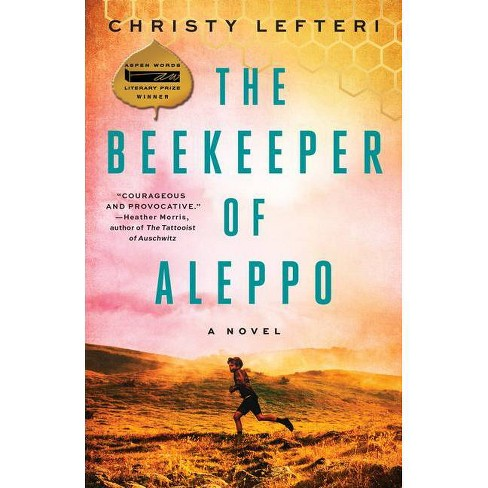
Nuri and his wife, Afra, have survived the arduous trek from Aleppo to the UK, and while they are awaiting their asylum application interview, they are staying in a B & B with immigrants with similarly devastating pasts. This waiting is not easy. Nuri is plagued by flashbacks of their escape from Syria, the trauma and losses they’ve experienced during the war there, and the anxiety about what lies ahead. But because he is seeing this trauma through his own eyes, he is finding it hard to connect with Afra, who is seeing it through her own. The question is whether or not they will find their way back to the family they know they once were.
This is not my first exposure to the refugee experience; though this may be one of the most poignant. I believe what contributes greatly to this is the sensorial nature of the author’s descriptions. We inhale Afra’s rose perfume as Nuri does,. We hear the buzzing of the hives tended to by Nuri and his cousin, Moustafa. And we can envision the stark colors of the drawings created by Afra, even when she cannot. And since we are right there in the sensory experience, we are also with them in their fear, their vulnerability, not knowing whom to trust, wondering where their next meal or shelter will come from or how they will get to the next step of their journey. We feel it in our bones.
In this depiction, we also see the worst of people and the best, as we do in most crises. We see the vultures who prey on the vulnerable, those who profit from those who are destitute and desperate and the corrupt underworld that feed off of this humanitarian nightmare. As Nuri gains the trust of others in his travels, he learns their stories and sees that his situation is not even the worst possible, and he feels deeply, especially for the plight of the many babies and young children refugees. On the other hand, he also encounters many who are kind, those who give food and clothing to the passing refugees, and those who do show compassion and support them in their journey.
I think this is an important read with an understated yet powerful impact that will linger with you long after you turn the last page.
Laura was no stranger to the streets of Manhattan in the mid-1980’s, but something made her stop and turn around after passing a small, skinny, Black boy asking for money on one fateful Monday afternoon. His name was Maurice, and he was half-starved, and when she invited him for lunch at McDonald’s, he accepted. Laura was careful not to pry too far, but could see that Maurice was fending largely for himself, and she was unsure if she’d ever even see him again or how that would happen. To her amazement, though, she did, every Monday from then on. From this bloomed an unlikely friendship that became a blessing for both Laura and Maurice.
This is a true story that is told from Laura’s perspective, but gives a great deal of background from Maurice’s family experience as well. Both of them have experienced a great deal of family trauma, although Maurice’s is quite dire, with most of his family falling victim to the devastating crack epidemic of the 1980’s. While Maurice is clearly loved by his family, particularly his mother and grandmother, they are both usually too ill to properly care for him and he is often left to his own, skillful, but youthful devices. When Laura meets him, he is living in a crowded single room with many drug-addicted relatives where there is no routine, no structure, and never any food in the fridge. Laura is the first person to ask him what he might consider being when he grows up, giving him a first glimpse of the possibility of a real future for himself, besides what he sees in his family.
On one hand, this story is inspiring. Laura speaks freely about how she has gained as much from the relationship as she has given. While she truly has given, whether in lunches made in brown paper bags – signifying to Maurice a show of love and care for him – or clothing, or just a periodic respite from his tumultuous family life, she has also received. She has not had relationships where she was able to have children, and I believe Maurice was sort of like a son to her. She was able to lavish attention, occasional gifts and intermittently share her wisdom with him, the way she might with a son, and she felt gratification in this. And certainly, Maurice was given something of a lifeline, in that he was shown a different possibility for how his life might be – that he did not have to follow the path of his family and that he could choose a steadier, healthier, and safer path for himself. And he did.
On the other hand, the story being written as it was also feels a bit self-congratulatory and almost cringe-worthy. We’re here again, with another white woman “saving'” a Black boy – and it just feels a bit uncomfortable to read about this. Laura is truly generous and giving – but why does she have to write about it? While “a portion” of the proceeds from the book are destined for the No Kid Hungry non-profit group, it still feels a bit strange.
I’d be very curious to hear what others feel about this book and this issue. I invite your comments! I am truly torn over this one!
Nour has already been uprooted with her family from New York to Syria, after the death of her beloved father. It has been hard to feel grounded, not to feel out of place, as she’s struggled to learn the language that comes so easily to her older sisters who had the advantage of having been born there. When disaster strikes, however, they must leave once again, and Nour must find the strength to search for the place she will ultimately call home, as well as determine who she really is. What guides and inspires Nour is her memory of the fantastical legend of Rawiya, who sets out to study the art of mapmaking, facing her own challenges and adventures.
It is stories like this one that brings the migrant crisis to a human level. We might read about thousands of people crossing deserts, oceans, and barbed-wired borders in search of freedom or safety, and it might be hard for us to connect to these realities. But when we come to know a 12-year-old girl, with 2 older sisters, who has painful memories of her deceased father, who feels out of place and awkward and is stuck in her own dreams and her father’s stories, we connect with her. And when she travels we travel and when she is in danger, we are in danger. And it’s hard and it hurts – and that makes it human. And that is the power of fiction – it makes things real.
What works in the novel is the simultaneous tale of Rawiya,. It serves as an emotional release from the intensity of Nour’s journey- almost a literary breath, if you will. More than that, though, it gives an opportunity to highlight the mystical and historic richness of the lands through which Nour is traversing. These lands of Arabia are vibrant and full of legend, and the story brings this to light.
Again, this is hard to read, but it is poetically written, colorful and imaginative. A journey of its own.
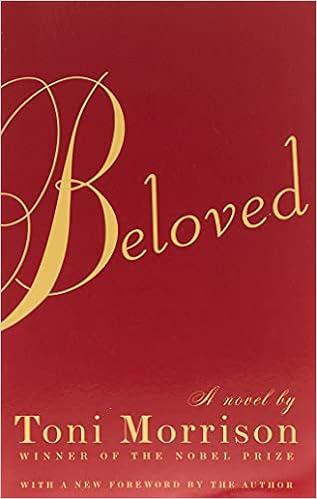
Denver and Sethe have found a rhythm in their isolated existence.. Even while they are haunted by an occasional eerie noise or movement from the unexpected, and even as they mourn the loss of Baby Suggs, their mother/grandmother, they have figured out a way to work and live and get through the days. It is only the arrival of Paul D who stirs up old trauma for Sethe, throwing her back into her past, forcing her to relive old horrors. And it is very unclear if their unusual little family will be able to leave the past behind and move forward.
Toni Morrison’s Pulitzer prize-winning Beloved, is beautiful, poetic, lofty, erratic, layered, and extremely hard to understand without guidance. It is likely that repeated readings are necessary to glean the most meaning from the text Because it was not set up as a traditional story might be, it was hard to get oriented to the characters, — who they were, where they were, and how they were related to each other. Once I did muddle through the first, maybe 10%, of the book, however, I was then able to appreciate the book for all its magnificent power.
There is a story here, but a non-linear one and one that mixes in much superstition, supernatural, and memory. In truth, it is a lyrical platform in which to lament the horrors of enslavement, the way in which enslavement robs us of our humanity. It is loosely based on a true story of a woman who, rather than allow her daughter to be captured and be enslaved, murdered her instead. This unthinkable act forces us to examine just how desperate a mother could be to choose death over a life of ownership by another individual. To choose death rather than not having freedom to choose whom one may love and form attachment to. To choose death over a life of being chained, both figuratively and literally.
Most powerful for me were the sparks of memories of Paul D and of Sethe as they went about their day to day on “Sweet Home,” the plantation where they’d originally met. Paul D harks back to a memory of overhearing an assessment of his monetary worth, as if one could place such a figure on a life. At another moment, Sethe remembers overhearing Schoolteacher showing his pupils how to list Sethe’s human qualities on one side of a page and her animal qualities on the other, reducing her to only partly human. There is physical brutality described as well, but I believe these more insidious crimes reveal more about how these individuals were perceived and how these perceptions seeped into their souls– even more so than the physical harm that befell them.
I feel that I’ve gotten so much from having read this book. If reading can impart some degree of empathy, Sethe’s story is an important place to start.
Victor Dalmau has found himself rooted, with only a few years of medical training, in the trenches of the Spanish Civil War, repairing the wounds of the Republicans fighting the Fascists who are seeking to rule Spain. While he is useless with a gun — quite unlike his brother Guillem, the consummate warrior — he finds purpose in healing those who are, and he supports them in their calling. Little does he know how deeply he would continue to feel the pain of injustice and persecution and how this early mission would direct the trajectory of his life and that of his family.
This is a beautifully written novel, based on the true story of one survivor of the Spanish Civil War. After this war, thousands fled first to France, were placed in dreadful concentration camps, and two thousand fortunate souls were rescued by the poet Neruda on a ship to Chile called the Winnipeg. In Chile, they were welcomed and given refuge and opportunity and allowed to flourish until there was political unrest there as well. Our hero, Victor, embodies the strong, immigrant character: hardworking, valuing family above all else, and devoted to the preservation of humanity and justice.
I am so thankful to have read this novel. In my ignorance of history, I have never known much about this tragic era in our world’s history. Learning it through the eyes of these gorgeous characters was, in my view, the best way to attempt to correct this, because the facts are interwoven with deep emotion, and this is how they are best etched into our memories. And while this is not necessarily an absolute/comprehensive and final look, it is certainly a great start to learning about this dark moment in Spain, France and South America.
And even while enlightening us about the historical period, the author does not neglect to interweave a complex plot, with suspense, subplots, and even romance that bear surprise twists. She keeps us intrigued with each step of Victor’s harrowing journey.
This is an important read for those who are are unaware of this period of history – and even for those who aren’t. And while I don’t like to overload the “MUST READ’s,” this has to be placed there – sorry!
Written by one of the most impactful writers of our time, this non-fiction masterpiece is a stark comparison of the caste system that we live with here in the U.S. and that which has existed in India for hundreds of years and that which enabled the rise of the Third Reich in Germany during World War II. In order to elevate the white, European (Aryan) male in both the U.S. and Germany, it was necessary to establish a scapegoat, or a group of humans deemed less-than, in order to maintain an identity of being higher than. Likewise, in India, it was necessary to invoke religious inspiration to insist that men are created with certain intrinsic value based on the class they are born into, rather than natural, proven talents/abilities. Those at the top convinced themselves (and are continuing to convince themselves) that those at the bottom were content with their lot – or at least, that this was a god-given right which they enshrined. The myriad historical details and the personal accounts only serve to enrich Wilkerson’s thesis and drive her very painful and compelling point home.
While this book is not an easy one to read, it is one of the most important books that help explain this moment we are living in. It is clear that the presidency of Donald Trump was not a cause but a result of a growing fear of white men of losing their power over all others (including women of all colors, by the way) in this country. The continued efforts of Republicans to gerrymander and inflict restrictive voting laws are clear evidence of their flailing attempts to grasp onto those strangleholds they view as their birthright. And, as Wilkerson so rightly points out, these restrictive and terrifying laws and movements, and the rising of the Alt Right, Neo-Nazi, and white supremacy groups, hurt everyone – including the perpetrators – physically and mentally. We all lose.
We owe Wilkerson a debt of gratitude for her years-long, painstaking research and her gorgeous writing that encapsulates it.
Again, everyone MUST READ this book – if you want to understand not only caste but the fundamental history of our country and what is happening in our country today.