Pineapple Street by Jenny Jackson

Sasha, much to her dismay, has left her clean, shiny, new apartment to move into her husband’s family’s 3-story brownstone in the historic “fruit” section of Brooklyn. Mind you, she appreciates the generosity of her husband’s extraordinarily wealthy parents for letting them move in there, but when she was told to make it her own, there were a bit too many caveats. She could not change the dark, long curtains that hung in the huge windows, because, well, they’d been made especially for those huge windows and what would you possibly find to fit those? And you couldn’t think about replacing the shabby old couch, even though it had given her a rash when she’d sat on it – because, well, you know it came directly from the governor’s mansion. Nor could her sister-in-law’s entire bedroom be cleared of the junk in there, because, well, she had no idea why. It drove Sasha completely mad. In fact, the way the family clung to their traditions, and to each other, if she were entirely honest with herself, sort of drove her a bit mad. But she did love her husband, Cord. And wasn’t it worth it just to be with him? Or was it?

Apparently, this is this author’s first novel, and I have to say, I can’t wait for her next! I enjoyed this novel from the very first page until the end of the acknowledgements. Her writing is crisp, clever, witty and had me giggling along as often as I was empathizing with her utterly delightful characters. We hear the story not only from Sasha, an artist from a middle class upbringing from a suburb of Providence, RI (center of the universe!), but from her sisters-in-law, Darley and Georgiana, who are the ultimate in NY upper crust, and so privileged they are completely oblivious to how privileged they are; that is, until it hits them smack in their clear-skinned, tanned and tennis-playing faces.

I also hold a special place in my heart for the Rhode Island humor hidden deep in these pages. References to the quahog and its appropriate pronunciation, the use of the word “bubbler” (anyone know what that is???), and teaching their kid to speak Rhode Island – I was sold way before that, but that clinched the deal. It was pure poetry to my Rhode Island-born ears. While you might not guess I am from there from my accent, I still carry a very treasured place in my heart for that tiny state that is not, in fact, an island.

This novel addresses class difference and social justice with a sense of humor, a light touch, and a kindness that might be a bit generous, but it is also done in a way that is digestible. I for one loved it and, as I said, cannot wait to see what is next from this very promising author. Because of the pure fun I had reading this one, I’m giving it a MUST READ!


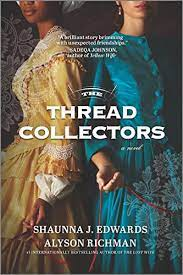
The Thread Collectors by Shaunna J Edwards and Alyson Richman

When Stella and William say a passionate farewell at the beginning of this story, they have no idea if they will ever reunite. William is an enslaved Black man in the South, escaping his master at the outset of the Civil War, and Stella is an equally indentured Black woman who technically is free but is “kept” by a White man for his “pleasure.” All William has is his flute and his magically musical ear, but this wins him a place by the side of his newfound friend, Jacob. Likewise, Jacob, a Jewish New Yorker, who has signed up on the side of the Union, with the dream of fighting to end slavery, has also bid goodbye to his true love, Lily. He also has no idea if he’ll be able to return to her, fearing the worst as he moves closer and closer to the front. All he can hope for is that her continued correspondence and her love for him will help him through his arduous fight.

This narrative was apparently based on true characters in the history of the two authors’ families. Each of them is writing about the marginalization and, particularly in the case of the Black men who fought for the Union, dehumanization, experienced by these soldiers. And how relevant is this story now? With the rise of antisemitism and racism that is rampant in this country – and worldwide – it is both tragically and unsurprisingly, unchanged. Both Jacob and William experience the feeling of being treated as less-than, socially, financially (William is paid less than his White counterparts in spite of doing their scut work), and in terms of supplies, food and healthcare. Moreover, I feel that many of us can, sadly, relate to the schism in Jacob’s family, as he finds that his brother sides with the South and defends the vile institution of slavery, while Jacob and Lily fight for abolition.

As a novel in itself, however, I feel it is just ok. While it tells an important story, and there are some gritty and heart-rending scenes, it is mostly on the predictable side and just a bit corny. A few coincidences are just too perfect and a few situations turn out just too well to believe.

On the whole, however, it is a worthy read and one can learn quite a bit about this slice of history, from a more insider, less glamorized perspective.

The Heaven and Earth Grocery Store by James McBride

Moshe never imagined himself worthy of such a catch as Chona, the beautiful daughter of the owner of the grocery store who, because of her limp, was reading in the back more than she was working in her father’s store. He was actually more focused on getting himself settled, out of debt, financing his theater, which he managed to do by inviting in the Negroes of the community of Chicken Hill as well as the Jews (a radical move in the early 1930’s in Pottstown, PA, where the KKK had its annual parade down the town center). But he managed to win her heart with his openness and his respect for her intelligence and free spirit. And they were happy together, their only disagreement being about where they should live, he believing they should move out of town, as most of their fellow Jews had, and she believing they were already home, with their Negro neighbors who had always been their friends and saw no reason for them to leave. Of course, he gave in to her, as he always had, knowing that their closest friends were right there with them, the Black couple who worked with them day in and day out, Nate and Addie. When this couple approached them with a request for a favor, Chona immediately said yes, setting them up for trouble they had no idea they were in for.

James McBride has a magical way of creating the most colorful characters who are flawed in the most gorgeous way possible. Chona, with her limp, her seizures, and her mysterious illnesses, is the most beloved character in all of Pottstown. Nate, with his inner turmoil and fury, has a quiet and kind exterior that earns him deep respect (and, yes, fear) from all who encounter him. And the bonds that form between these beautiful, sometimes comical, sometimes tragic characters, often of different races, are borne of longstanding histories of common suffering and oppression. By necessity, yes, but also by loyalty and friendship as well.

Herein also lies a commentary on how the mentally ill were treated at the time, which is to say that they were not treated at all, but rather locked away from society, and at the mercy of generally untrained, unkind, and unsupervised caretakers. Utter chaos reigned and heaven help anyone who was brought to one of these facilities. Moreover, it was a random path to finding oneself there, as “diagnosis” was random, not scientific at all. One could be physically ill, deaf, speak a foreign language, or just have a different view of life and find oneself declared mentally ill. And if you were not mentally ill when you first got there, the “treatment” there would ensure that you would be after a short time.

This is a powerful story, there are powerful commentaries on life in the US as non-white folks, and it is well worth the read. Don’t miss it!


The Covenant of Water by Abraham Verghese

Mariamma is only 12 when she’s told she is to be married off to an older widow. There is nothing to be done, as this is her fate, just as it was for her own mother and those who came before her, in her home in southern India at the start of the 1900’s. She is, in truth, more worried for her dear mother, who herself has been widowed and is now at the mercy of her father’s brother, who perceives her more as a burden than as family. But Mariamma knows she is loved, knows how to love, and this serves her well. She enters her new home with an open heart and embarks upon a journey that brings her both great joys and deep sorrows.

This is a gorgeous family saga that enriches the reader with a deeper understanding of not only Indian culture, but of a bit of the unrest that ensued after the liberation of India from British rule. We immediately bond to Mariamma and her life becomes part of our own. When the plot shifts to focus on Digby, a young Scottish physician who comes to India on a quest to get practical surgical experience, we find ourselves adopting him as well. The characters and their stories are authentic, vulnerable, and gritty and we can’t help but get swept up in their struggles and their joys.

One of my favorite characters here is Mariamma’s husband, who is referred to as Big Appachen. He is a man of very few words, but his actions speak for themselves. He is generous beyond words – he rewards those who are loyal to him (and sometimes those who are not) with land grants and opportunities – and tries to overlook the traditional caste system that divides the people who work for him. While he does not express what he feels verbally, he shows it in the most important ways – through his protectiveness, his generosity, and his kindness. (I know I could learn from this, being one of many words.)

I loved this book. I believe these characters will live on with me for a very long time.

Give yourself the gift of reading it – you will not be disappointed! For sure, a MUST READ!


In the Dream House by Carmen Maria Machado

In this memoir, Machado shares her experience of a relationship with a beautiful woman that begins as dream-like and erotic and devolves into terrifying and abusive. Through a course of poetic essays, with the Dream House imagery as theme, she portrays how she is entranced, then entrapped, and then, finally, enraged enough to free herself from the woman who has gripped her heart and fractured it in two.

This is, apparently, one of the rare portrayals of queer relationship violence/abuse that is documented by literary means. While books about heterosexual abuse abound, the queer community has been more silent on this topic. It is not uncommon for a marginalized community to feel a loyalty such as this, to hold itself to a higher standard, to try to appear to have achieved a higher ideal. Doing so is an understandable way to try to protect those in the community from further criticism, because, surely, they receive enough as it is. However, by doing so, it denies those who identify as queer as having others believe them , understand their plight, and have others who openly support and identify with them when it does occur. And spousal abuse/relationship abuse can happen to anyone – anyone is vulnerable, no matter your gender identity, your sexual preference, your race, your religion, your ability, your size. This is the harsh reality.

The writing here is poetic and ethereal. The image of the Dream House as both positive and negative images captures the internal struggle of the victim of abuse and the subsequent gaslighting. There can be so much wonder and love and light, but there is also so much darkness and hatred and doom – and it can change in a heartbeat from one extreme to the other. The victim walks on eggshells, constantly apologizing for her own existence. She feels she must have brought this on herself, she must deserve what is happening, because, really, what else could it be? How could someone love her so much in one moment but then hate her so much in another? Maybe if she just acts better, IS better, she can make it right. But of course, it is not her – it is her abuser who is at fault. This is so painfully hard to see when you are in it.

Machado has very generously opened her heart to us. I hope that others come forward with their stories as well in order to create the supportive community that is necessary to acknowledge that this can happen to anyone, queer or otherwise.


Happiness Falls by Angie Kim

“We didn’t call the police right away” laments Mia as she begins to unravel the tale of what happens after her autistic, non-speaking younger brother Eugene, returns from his therapeutic exercise in the park without their father. Eugene is clearly traumatized by what has happened in the park, as demonstrated by his persistent jumping to calm himself for hours and hours, but the family is unable to assess from him what exactly has occurred. As the family searches for their father/husband, in what becomes a missing person mystery, they also learn more about both him and about Eugene – and while the lessons become harder and harder, they also bring the family closer and closer.

As Mia reflects on her search for her father and the family’s approach to figuring out what might have occurred between Eugene and him in the park, Mia realizes that she has been self-absorbed, as a 20 year-old college student might be, as well as biased, as any of us might be.  As she learns more about her father and what he’s been analyzing during his time as a stay-at-home dad, she cycles through various reactions. Similarly, as it slowly dawns on her that her brother Eugene, is capable of much deeper thought than she’d previously understood, she has a mixture of emotions as well. Because her brother is right in front of her, this becomes a crucial part of the story.  Not only does she realize that one’s ability to speak may not be reflective of their verbal skills (they may just not have the ability to actually  vocalize their internal dialogue), but moreover, that one’s verbal skills are not the full picture of one’s overall intelligence, as she’d presumed. 

I certainly appreciated this book for opening my eyes to the possible deeper intelligence of those I may have judged erroneously as having less intelligence just because of their challenges with communication. Whether it is a language barrier because of a foreign nationality, a look that is different from our own, or behaviors/movements that do not match those we may associate with “normal” (whatever that might mean). we presume, judge, and miscalculate others’ abilities based on biases about which we are not even conscious. These feed into our understanding of those around us and we may be dismissive — even rude —  without even realizing we are being so. It is so important that we open our minds and our hearts to these possibilities, because only then can we become aware and hopefully prevent these insults, offenses to others. And in this moment of polarization, the more we can come together, the better.

And not to worry – there is of course also a story here, with a plot, characters, and suspense. It is not preachy, nor bogged down in too much detail. We do empathize with Mia as she parses out her discoveries. and we also develop a strong attachment for Eugene as we discover his personality, his humor. There is warmth without the saccharine. 

A definitely recommended read!  


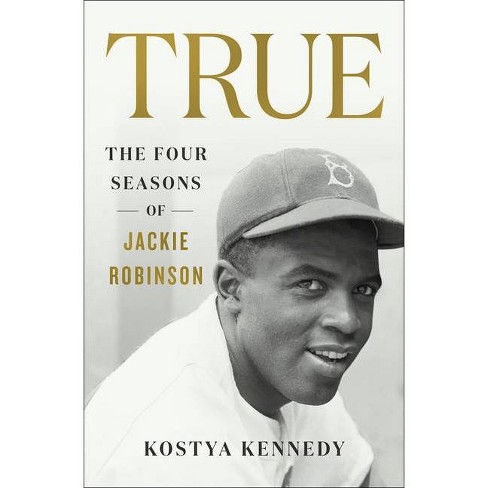
True: The Four Seasons of Jackie Robinson by Kostya Kennedy

Jackie Robinson broke barriers. He broke through barriers when he joined the Montreal Royals, and then he broke through even more dramatically in the US when he joined the all-White, Major Leagues, as a Brooklyn Dodger. With his unique batting stance, his gutsy base-stealing, and his overall agility and competitive exuberance, he was a shining light for his team and for anyone lucky enough to be in the stands to watch him play. And while he encountered innumerable incidents of racism, he always maintained a calm demeanor even as he spoke his mind plainly. Through his larger-than-life image of poise and strength of character, he and his wife, Rachel, became integral to the advancement of civil rights in our country.

In this colorful depiction of the life of Jackie Robinson, we are given an insider’s view of his life and his struggles, his victories and his pain. Kennedy, through extensive research and a clear understanding of the game, gives us not only detailed descriptions of pivotal games played by Robinson – helping us to feel almost as if we ourselves are sitting in the stands – but also how Robinson must have felt during those games. We are deeply disappointed and hurt alongside Robinson during tours in the South, as he eyes his fellow teammates remaining on their bus destined for their all-White luxurious hotels, when he has to get off the bus to stay at a Blacks-only hotel or private home. We feel the resentment he feels as he continues to see, year after year, no Black managers or team officials in spite of his continued advocacy for this. But we are also thrilled by his wins and inspired by his accomplishments.

What I loved about this biography of Jackie Robinson was the tribute given to his wife, Rachel. It seemed that Robinson himself gave her so much credit for his success – and that was evident here in this book. Theirs was a true love story; they seemed to be a genuine team in love and in life. While she was a homemaker for much of his baseball career, she was trained as a nurse and an educator, and she returned to working once their children were grown. Later, she also helped to forge the advocacy and fundraising he began, long after his death.

You definitely have to have an interest in baseball to get through this book, as there are many detailed descriptions of games, plays, and players. But if you do, you will also learn quite a bit about how baseball lived as a metaphor for many, particularly those in the 1940’s and 1950’s, in Jackie Robinson’s heyday, for some movement toward the advancement of civil rights in this country.

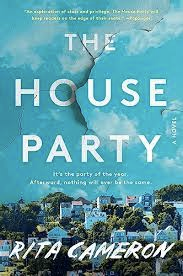
The House Party by Rita Cameron

Aah, the year is finally winding down for the students at New Falls High School and they are ready to party.  Will and his older brother Trip are definitely on board, but when they arrive with the beer, they are a bit surprised to find that this one is taking place at the fancy new house being built on the river. Well, Will deserves to party just like the rest of them, doesn’t he? He’s worked so hard to get to where he is – a senior, with a well-deserved acceptance to Princeton and a scholarship from the town’s board. Little does he know how out of control this particular party would get – and how it would impact the course of his life, his family’s, and the lives of the couple building this new home.

This novel, set in a small suburb of Philadelphia just prior to the economic crash of 2008, is a well-crafted indictment of the “lawnmower parent,” the parent who smooths the way for their child at all cost. (Usually wealthy and/or privileged, these parents don’t allow their children to suffer any consequences of their actions; hence these children do not learn that they are to be held accountable for what they do.) We hear the story from the perspective of the teenagers – who are mostly of age (18 or older) – but we also hear it from the perspective of the homeowners who are building their dream house – which, of course, gets demolished. We feel for the children who, yes, have made a mistake and their futures are at risk. But we also understand that they need to be held accountable and restitution made for the damage they’ve created.

We also feel for those who are more vulnerable, those with less means. Even in a town that prides itself on the peaceful blending of the working class and the “newer money” families at the high school, there is a clear division between who the DA’s office deems disposable and who is protected, who can be targeted and whose reputation must be preserved. Meanwhile, we see how quickly this status can change, with the onset of the troubles of the couple who are building the home. No one is immune to this possibility.

This is such an engaging read with a social commentary so important, I believe, that I would consider this a MUST READ. I’d be curious to hear what others think!


Honor by Thrity Umrigar

Much to Smita’s dismay, she has been brought back prematurely from her vacation in the Maldives to India, where she’s sworn to herself not to return. And worse, she has been brought back not to tend to her friend, as she’d believed, but rather to take over her friend’s news story that is quite controversial. The story is that of Meena, a Hindu woman who dared to marry a Muslim man. Seeing this as a slight against their honor, Meena’s brothers sought vengeance and torched her husband to death and left Meena maimed by the fire. She is now awaiting the verdict of their revived murder trial and Smita must cover the story. But at what emotional cost to herself?

This is an extraordinarily trying narrative to take in – not only as a woman, but as a human. The repugnant misogyny and collusion chronicled here is not unique to India, but exists around the globe, and is promoted, even exalted throughout. So often, whether in the name of God, religious extremism,  or just “family honor”, women are treated as if they are either property of men or as if they do not exist at all. Even here in our first world country it exists, where women’s rights are being chipped away daily, leaving us with less pay, less agency over our bodies, our choices, our rights to be our truest selves in this world.

The writing here is crisp, the imagery vivid, and the characters capture our hearts immediately. We are curious about Smita’s struggle with her homeland and her story is also extremely powerful, also rooted in hateful extremism. It is clear why she is a journalist and why she seeks to document the world’s troubles. She has been borne of them and has lived them.

This novel is well-written and while it is a painful book to ingest, it carries a message that must be heard. I very highly recommend it – but definitely not a “beach read!”

The Reluctant Fundamentalist by Mohsin Hamid

In this novel, we meet Changez, as he relates the story of his youth to an American stranger he meets in a public square in Pakistan. We hear about his journey to Princeton and then to New York, his successes and struggles as he moves forward academically, socially and romantically. We also learn about how his experience as a brown man following the attacks on the Twin Towers become pivotal to his relationship with America as a whole.

What is most unique about this book is the voice used to tell the tale. Changez is sitting with the American, whose name we never learn, and we hear his side of the conversation throughout the narrative. It is a wonderful way to convey the story, in that we can envision the two men, dining at a table in the market square, as the light dims with the passage of time.

While this conversation scene is fairly tranquil, the subject matter is not. Changez is subjected to constant “othering” during his stay in the US. Even prior to the World Trade attacks, he is never quite included in social circles, never quite one of the crowd. Even in his romantic relationship, which is more imaginary than real, he is never loved or appreciated for who he is, but rather tokenized and used. One can certainly understand the rage that gradually builds and builds until he finally, much to his own surprise, implodes.

This is an iconic work. It is a quick read, but has so much to teach us packed into its pages.