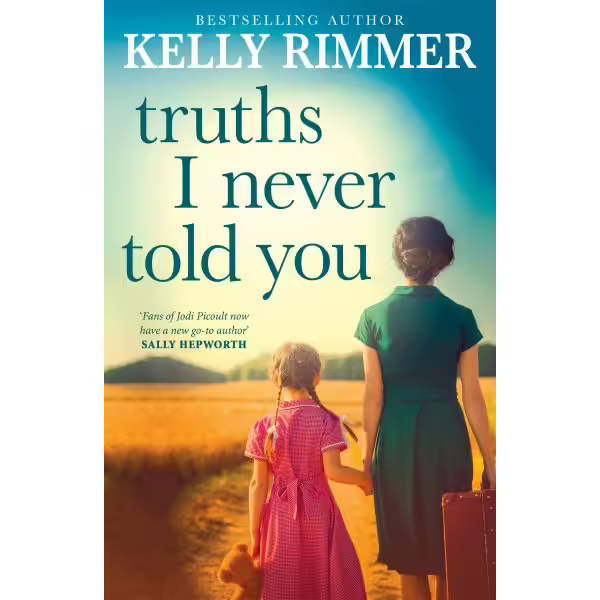
Truths I Never Told You by Kelly Rimmer

Grace is on the brink and she doesn’t know where to turn. She knows she can’t be trusted with the care of her own children – she just can’t pull her mind out from under the dense blackness that has taken root there, and she knows that it’ll happen again if she has another child. It’s happened each time before. She just has nowhere to turn.

Decades later, Beth is grappling with her own frustration. She is clearly just stressed – her father is dying, she’s sleep deprived from a new baby, and she’s just not feeling up to going back to work yet. So why is everyone on her case, asking her what’s wrong? She’ll be fine. Won’t she?

The narrative between these two women brings us back and forth through the generations of this vulnerable, tender family and winds us through a beautiful story of love, heartbreak, and resilience.

The difference between these two women is also just one generation, and the epic difference between their generations is the passing of Roe v. Wade. One generation has the luxury of choice – the other lives without any control because they do not have that access.

I find myself writing this post on the morning that the Supreme Court of the US, staggeringly, has announced the repeal of Roe. I am still numb from this, even having tried to brace myself for what I knew was coming, although I still held out hope that some of the judges would come out on the just side of history. But no, the 6 conservative judges’ allegiance to their biased, misogynistic, utterly anti-life, hypocritical base was clearly too strong a tie.

Women will now return to the back alleys, the sepsis-inducing, life-threatening, desperate means of trying to gain control of their lives, which men put them at risk of, once again. Women will have to endure pregnancies they do not want, bear children they’re not ready to care for, and those children will likely live in conditions that are sub-par, to say the least, because those same Conservatives never vote for safeguards for these children once they are born. Hypocrisy at its very gravest.

Health care should be left to health care providers and their patients. Everyone else should stay out of it. Abortion and contraception is health care. Period.

This is a MUST READ at this time – I really wish the SCOTUS judges had read this novel before writing this decision.

The Other Americans by Laila Lalami

Nora cannot reconcile the guilt she feels that while she was relaxing over a celebratory glass of champagne with her roommate, her father was, at that very moment, tossed into the air by an as yet unidentified driver and killed. Nor could she believe, even through her profound grief, any possibility that this was a random accident. All she had to do was convince others to see things from her point of view as well. Would she be able to do this, without any witnesses, without anyone coming forward in her favor? Especially when even her family was willing to accept the party line…?

This is an excruciatingly timely story, as it addresses the deep-seated fear and resentment that so many white folks have toward any immigrant that has achieved any modicum of success. This “replacement” conspiracy theory once again rears its hideous head here.  Nora, a smart, talented, but dark-skinned, Muslim girl has been left out and “othered” most of her life, growing up in their desert town near Joshua Tree. Similarly, she’s observed her father, a hard-working immigrant from Casablanca, survive being targeted by racial incidents as well. While Nora has found solace in her music, she’s continued to experience micro-aggressions repeatedly and continues to struggle with navigating her way through. 

The author makes excellent use of a rotating narration, imbuing a distinctive and familiar voice to each character.  It feels as if we are sitting with the characters, hearing their side of the story as it is told perhaps in an interrogation room to the investigating officer.  We come to know each character deeply, understand their passions, and feel their pain. It works.

One character that is particularly endearing is Efrain, the singular witness. I will not give away details about him or his perspective, but he is portrayed beautifully and his struggle over coming forward is both understandable and tragic.

This is an engaging story with a powerful message – a worthy read! 


Beartown by Fredrik Backman

If you don’t play hockey, or follow hockey, or at least tolerate hockey, you will not last long in Beartown. The entire population, intimate as it is, is consumed with it. Kids begin skating once they can walk, and everyone is on the lookout for those charmed few, those who have that natural gift, that drive, that will send them through to the A-team. Kevin certainly has it, and with Benji at his side, fighting off any opponent who might threaten his path, he is a sure shot. That is, until a crime is committed, which might just change everything.

Fredrik Backman is another writer who, by virtue of the beauty of his writing, has me convinced that there is no way I should ever even think of trying to write. He has the uncanny ability to weave complicated, layered, and realistic plot lines around complex and gorgeous characters.  And unlike with some novels with so many characters, we come to know each one so well that we never confuse any of them, never wonder who is whom, because we have fallen in love with most of them. The warmth with which he imbues them grants them their familiarity. They become our dear friends.

Also, there is a beautiful message here about the challenge of loyalty; whether that be loyalty to one’s family, to one’s friends,  to one’s team., or to one’s own values. Most of the characters find themselves wrestling here with conflicting loyalties. and some impress us and some disappoint us. But all of them are so stunningly human in their struggling. My favorite is Ramona, who is a bartender. She’s depicted as someone who’s seen it all, and who has been loyal to those who have lost the loyalties of most everyone else. She sees people for who they are, not who they profess to be. I would love to be more like Ramona.

This book has it all – characters, plot, warmth, important message – all the makings of a MUST READ!


Shrill by Lindy West

In this memoir, Lindy West shares her alternatingly traumatic and triumphant experiences as a feminist writer venturing into online journalism. Because she is also fat (her self-description), she also becomes a target in our fat-phobic, one-size-fits-all-definition-of-beauty society and is branded by trolls with repulsive vitriol. When she tries to stand up, for example, against comedians who use rape as a topic for jokes (which is about as funny to most women as I imagine Putin is to most Ukrainians right now), she gets accosted online by the most offensive trolls imaginable, with comments liked by some of her friends. (It is pathetic how quick people are to take sides against those who are perceived as vulnerable.) Lucky for women, she is a strong, smart, and good-hearted person who rises above and sees the forest for the trees, speaking out for all of us. She proceeds to make history in her accomplishments, one troll at a time.

This book is replete with paradoxes. West is vulnerable yet powerful. She puts herself out there, stands up and stands out in a public forum, knowing she’ll open herself up to criticism – and omg, does she – but yet she stands up again and defends herself so strongly that she silences others to a screeching halt. She hears the noise, feels it, but does not allow the noise to infect the clarity of her argument. Despite feeling isolated, she thinks about women in general and not just herself as a woman. She also sees herself as others see her, yet she will not bend to their perception of who she is.

Some may find her story stirring, even jarring. We are not used to hearing women with loud voices. We are not used to hearing women be comfortable and secure in larger bodies. We are not used to hearing women stand up for themselves when they have strong opinions and strong minds, especially when they go against the (male) grain. But I know it’s about time we got used to hearing and appreciating them!

Homegoing by Yaa Gyasi

This epic tale begins with the birth of Effia, born during a fire that devastated her father’s crops, a harbinger of the impact that fire would have on generations to come. And as we learn about the generations that follow, we also learn about the history of the warring tribes that inhabit the Gold Coast of Africa as well as the movement of enslaved Black men and women to America and their experience through generations there.

This is another work of genius by Gyasi. Through many endearing characters and colorful and impassioned scenes, we learn about the history of the peoples of current day Ghana as well as how so many came to be enslaved in America. We learn, too, about their experience of continued oppression beyond the years of slavery in the US as well. The stories are so tactile and sharply painted, the reader cannot help but feel a connection to the many characters, as if we are traveling along the family’s lineage ourselves, through each generation.

And Gyasi omits nothing. She includes the dark reality for those who migrated north seeking relief from enslavement only to find continued prejudice and rejection in different forms. She includes the ugly truth about our history of replacing slavery with mass incarceration. She writes about our American reality now and how, in spite of some change and advancement, divides persist.

It’s a beautifully rendered portrait of the not-so-beautiful history of Ghana and the history of our country. Yes, another MUST-READ.


The Girl with Seven Names by Hyeonseo Lee

Born in Hyesan, North Korea, Hyeonseo Lee was raised, as all of her peers were, to believe that her country was the “Greatest Nation on Earth.” Indoctrinated from the time she was born to worship the leaders of her country above all else, she witnessed at the age of 7 what happened when one opposed the regime: public execution. But even while she felt the pressure to blend in and follow the party line, she noted that there were, in truth, stark differences in how people lived. While the communists sang about equality among the people, how their government provided for its people, Hyeonseo observed that a family’s social status determined just how much that government actually provided. In reality, it was far from an equal distribution. And while she was privileged to some degree, this privilege did not protect her family from political danger. In this memoir, she shares her utterly harrowing story of her years-long journey toward freedom.

If you’ve followed this blog, you will note that I have been reading quite a bit about various refugee experiences. All of them are impossibly harrowing, but none has read more like a suspense novel than this one. At every turn, this young woman and her family encountered unimaginable peril, always being on the verge of disaster and often experiencing heart-wrenching disappointment and suffering. They were constantly at the mercy of others, usually being preyed upon by corrupt officers and traffickers alike, rarely reaping the courageous generosity of others, even strangers. Most profoundly, once they finally did achieve freedom, they actually had to be taught that humans deserved fundamental human rights in order to understand how deeply their own had been violated.

The bravery and dedication to family demonstrated by this heroine is infinite. She is an inspiration to all of us, particularly in this moment when we are seeing so many fleeing their homes in search of safety. It reminds us that no one chooses to leave their home. One leaves only when there is no other choice.

I’d like to depart from my usual post and add a poem which I found deeply moving (shared with me by an inspirational leader for whom I am so grateful):

Home by Warsan Shire

no one leaves home unless
home is the mouth of a shark
you only run for the border
when you see the whole city running as well

your neighbors running faster than you
breath bloody in their throats
the boy you went to school with
who kissed you dizzy behind the old tin factory
is holding a gun bigger than his body
you only leave home
when home won’t let you stay.

no one leaves home unless home chases you
fire under feet
hot blood in your belly
it’s not something you ever thought of doing
until the blade burnt threats into
your neck
and even then you carried the anthem under
your breath
only tearing up your passport in an airport toilet
sobbing as each mouthful of paper
made it clear that you wouldn’t be going back.

you have to understand,
that no one puts their children in a boat
unless the water is safer than the land
no one burns their palms
under trains
beneath carriages
no one spends days and nights in the stomach of a truck
feeding on newspaper unless the miles travelled
means something more than journey.
no one crawls under fences
no one wants to be beaten
pitied

no one chooses refugee camps
or strip searches where your
body is left aching
or prison,
because prison is safer
than a city of fire
and one prison guard
in the night
is better than a truckload
of men who look like your father
no one could take it
no one could stomach it
no one skin would be tough enough

the
go home blacks
refugees
dirty immigrants
asylum seekers
sucking our country dry
niggers with their hands out
they smell strange
savage
messed up their country and now they want
to mess ours up
how do the words
the dirty looks
roll off your backs
maybe because the blow is softer
than a limb torn off

or the words are more tender
than fourteen men between
your legs
or the insults are easier
to swallow
than rubble
than bone
than your child’s body
in pieces.
i want to go home,
but home is the mouth of a shark
home is the barrel of the gun
and no one would leave home
unless home chased you to the shore
unless home told you
to quicken your legs
leave your clothes behind
crawl through the desert
wade through the oceans
drown
save
be hunger
beg
forget pride
your survival is more important

no one leaves home until home is a sweaty voice in your ear
saying —
leave,
run away from me now
i dont know what i’ve become
but i know that anywhere
is safer than here


The Four Winds by Kristin Hannah

Although she’s been told she’s worth nothing her whole life, Elsa still dreams of a world in which she might accomplish something worthwhile. Being 25 and unmarried in the early 1930’s is a pretty clear indication that chances are slim that you will be leaving your family home at all. No, you’ll likely be under the thumb of your overbearing, critical mother and father your whole life. Unless you take action. Unless you do something drastic – like maybe buy that bolt of bold, red silk and sew yourself that beautiful, lavish dress and just sneak out for that night on the town and pretend you’re like everyone else– to hell with what they say. Be brave, her doting grandfather used to say to her. Well, she just might. Little does Elsa know that being brave will have to carry her through all of what comes thereafter, as she takes each next step, wanted or not.

In The Four Winds, Kristin Hannah has written what will inevitably come to be known as a great American novel, a sort of Grapes of Wrath narrated through the voice of a woman. We are lured inside the head and the heart of our heroine, Elsa, a modest, resourceful, and hard-working woman, bitterly rejected by her own family. She easily earns our sympathy, as she gradually gains her own strength, visualizing her own purpose. We feel love when she is finally loved and we shed tears when she is hurt, and we applaud her as she overcomes one arduous obstacle after another.

This is also a story of a dark era in our history. The Dust Bowl crisis during the Great Depression was a tragic consequence of the prolonged drought that occurred during the 1930’s, and layered onto the economic crisis of the Depression, it could not have come at a worse time. Scorched farmlands bankrupted thousands, and, lured by advertisements for jobs, too many fled west and found only steeper poverty and absent resources. The narrative starkly highlights the failure of our country to adequately provide for those who were left with nothing.  This left those who were more fortunate, empowered by their vigilante groups, to demonstrate only anger and hatred toward these folks who were starving for work, starving to have the opportunity to help themselves. 

I love that the women here are strong characters. Elsa grows into a strong character as she comes to know herself. Her daughter, Loreda, is born strong – rebellious, with a righteous anger that is sometimes misdirected but always idealistic. And there is Elsa’s mother-in-law, Rose, with her quieter strength – a woman who is fiercely loyal, uncomplaining, and who has the softest heart and is present when it matters. These are beautiful characters who will likely stay with you long after you finish turning the pages of this novel.

This story will singe a hole in your heart, but it will also fill it with admiration for the souls who fought for others, to raise up the unfortunate. It also reminds us how frequently history does repeat itself and how important it is to learn from the past.

A definite MUST READ – and a future classic.


Born a Crime by Trevor Noah

In this tender memoir, Trevor Noah shares his experience growing up during the final edge of apartheid in South Africa. Through vividly narrated vignettes, we learn about his complicated relationship with his mother, who is fiercely devoted to him and yet is independent, stubborn and vulnerable. We learn of his early struggles to find himself, and how he must battle against the vicious cycle of poverty that apartheid has inflicted upon his people.  

It was suggested to me to listen to the audio version of this book – and this was excellent advice.  Hearing Trevor Noah narrate his own story, in his own beautiful, South African accent and fluidly modulating to his family and friends’ voices and accents, is just a gift to yourself. 

Noah is a brilliant storyteller.  He shares his experiences with such warmth and humor, as if he is sitting with you in your living room, over a cup of your favorite hot tea – but as if he’s sharing his deepest, darkest memories, only with you.  He describes in colorful detail some of the most outrageous adventures and unbelievable experiences.  But even as he shares his joy and his pain, it is as if he is flickering a smile at you, as if to say, we can still laugh, even as we hurt.  This is how we cope.

You will be engrossed and amazed — you will gasp and you will laugh out loud.  Don’t just read this one – listen to it!  

It’s a “MUST READ” but more than that, it’s a “MUST LISTEN!”


The Beekeeper of Aleppo by Christy Lefteri

Nuri and his wife, Afra, have survived the arduous trek from Aleppo to the UK, and while they are awaiting their asylum application interview, they are staying in a B & B with immigrants with similarly devastating pasts. This waiting is not easy. Nuri is plagued by flashbacks of their escape from Syria, the trauma and losses they’ve experienced during the war there, and the anxiety about what lies ahead. But because he is seeing this trauma through his own eyes, he is finding it hard to connect with Afra, who is seeing it through her own. The question is whether or not they will find their way back to the family they know they once were.

This is not my first exposure to the refugee experience; though this may be one of the most poignant. I believe what contributes greatly to this is the sensorial nature of the author’s descriptions.   We inhale Afra’s rose perfume as Nuri does,.  We hear the buzzing of the hives tended to by Nuri and his cousin, Moustafa.  And we can envision the stark colors of the drawings created by Afra, even when she cannot. And since we are right there in the sensory experience, we are also with them in their fear, their vulnerability, not knowing whom to trust, wondering where their next meal or shelter will come from or how they will get to the next step of their journey. We feel it in our bones.

In this depiction, we also see the worst of people and the best, as we do in most crises.  We see the vultures who prey on the vulnerable, those who profit from those who are destitute and desperate and the corrupt underworld that feed off of this humanitarian nightmare.  As Nuri gains the trust of others in his travels, he learns their stories and sees that his situation is not even the worst possible, and he feels deeply, especially for the plight of the many babies and young children refugees.  On the other hand, he also encounters many who are kind, those who give food and clothing to the passing refugees, and those who do show compassion and support them in their journey. 

I think this is an important read with an understated yet powerful impact that will linger with you long after you turn the last page.  


Before I Let You Go by Kelly Rimmer

It’s been 2 years since Lexie has heard from her sister, Annie, but she knows that her call can only harbor some tumultuous disaster.  Chaos has always followed Annie, ever since their messy youth, and Lexie has always been there to be the adult in the room and to pick up the pieces for her.  But this call… this blow may be more than even Lexie may be able to patch back together for her.  This may be the one time that Annie may have to rise to the occasion and solve it for herself.  

From the first page, we are locked in.  Rimmer’s writing is fluid and compassionate although we can sometimes guess where the plot will take us, we are still so fond of these endearing characters that we feel compelled to keep turning the pages and follow them through their painful and hard-earned wins and losses.  As the narrative bounces back and forth between Lexie’s current day experience and Annie’s journal entries, we are given a window into both what is happening now and what their explosive past has been like for each of them.  And we cannot help but become emotional as this tender and tragic and beautiful story unfolds.

There is so much to unpack here, but I will try not to give too much away as I try to do so.  One major theme is the injustice of our patriarchal laws around maternal-child welfare.  Our laws that protect the unborn are geared to protect children, yes, but they completely ignore the woman who is hosting the growth of that unborn not-yet-person – and this is obvious throughout this story.  This problem with our judicial system is magnified if that woman/host is afflicted with any kind of addiction.  She is blamed for having a disease that is out of her control.  We do not take away babies from mothers who do not care for their out-of-control gestational diabetes- nor should we! –  but we imprison mothers who use illicit substances while pregnant.  These mothers all have medical issues that need to be addressed, but because one is considered “bad” and one is considered “medical” we place a moral judgement upon one vs the other.  As is pointed out in the novel, we should be spending the money that we use to imprison these women on evidence-based treatment for these mothers, parenting support when the babies are born and on early childhood interventions, if we REALLY want to benefit these children.  Children generally do best when they are with their families.  This is highlighted here so very starkly and appropriately.  

Families are complicated and messy and Rimmer gets this so right.  You cannot help but have your heart melt from this one.  

Another MUST READ!