One Way Back by Christine Blasey Ford

Within these pages, Christine Blasey Ford reclaims her narrative – without distortion by the media, by politicians, or by any outsiders – of the facts of her experience of sexual assault by the man who is now sitting on the highest court of our land, Brett Kavanaugh. It is here, with a clear mind, a clear conscience, and clear focus, that she is able to communicate her backstory, her patriotic motivation, and the attempts she made to tell her story earlier in order to prevent Kavanaugh from coming to the point of being nominated in the first place (and in so doing, having to be exposed as he was). She tells about her experience of presenting her testimony and the abhorrent dereliction of duty of the FBI in their non-investigation of the case against Kavanaugh. She also bears her soul about the way in which she endured death threats, shaming, and other hateful acts against her that so many other survivors of sexual assault share – the backlash and the victim-blaming that comes with coming forward. She also shares the moments of support, from those whose names we recognize and those we may not. It is an inspiring, albeit painful, recounting of her journey.

It was our hope, at least that of those in my circle, that we in our country had learned our lesson after Anita Hill. That after our horrific treatment of that courageous woman who stood in front of a panel of old White men who battered her with ignorant questions and brazenly shamed her and disregarded her – we hoped we’d do better when another woman so bravely came forward to challenge the character of a man we were choosing for the highest court in the land. But no, we did not. One might argue that we did worse. We instead chose to discredit, shame, and mock Blasey Ford, who so boldly came forward to do her civic duty, who gave up her own quiet, private, comfortable existence to reveal such personal, intimate details of her life in order to bring a man’s questionable background to light. And it was worse because of social media, the 24-hour news cycle, and the internet access to personal information that enabled thousands to send her hate mail and death threats via so many different routes.

In a country of how many millions, we couldn’t find anyone better than Kavanaugh? There was really no one we could find who HADN’T sexually molested anyone??? Seriously? Oh, but of course we had to choose him. Because we have to only choose those farmed and nurtured by the Federalist Society in order to ensure the most conservative justices to make the most civil rights-limiting decisions on the bench. Because heaven forbid that anyone except White men have any power.

And yes, I am using this platform to rant because Blasey Ford needs to have others support her, to hear her, and to acknowledge that she did the right thing by coming forward and speaking up for herself, for women, and for this country. Because she is right. If little by little, woman by woman, each brave soul comes forward (in spite of the vicious backlash and victim-blaming that so often occurs), perhaps our daughters might have a spitting chance of having a better world. Perhaps our daughters will live in a world in which there are men who are more aware of consent and what defines assault. Perhaps when a woman comes forward, the folks in the room – however large that room may be – will actually hear her.


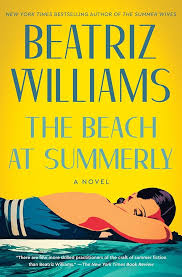
The Beach at Summerly

Emilia, whom most on Winthrop Island know as Cricket, has had something of an idyllic upbringing. Although her family works for the Peabody family, who only grace the island during the summer, she has always seen no difference between herself and the Peabody boys with whom she and her siblings were constant companions from Memorial until Labor Day. But things appear changed for all of them now that each family has lost a son in the second world war, and the sons who have returned have done so having seen what the world could impose. When the Peabodys’ aunt shows up with her children and an offer of a job for Cricket, this opens up possibilities – and danger – for Cricket and for her family.

Once again, Beatriz Williams has written a wonderfully crafted novel with all the ingredients of a MUST READ. We love Cricket, because she is smart, loving, and trying her best to do what is right. Nevertheless, she is of course caught up in a tangle of historical fictional intrigue and there are more than a few sections that even I, who tries to really read every word of a book, found myself glossing over some to try to find out what happens, because I NEEDED to know!

In this novel, we also see how the “bad guys” are not always necessarily “bad,” but just victims of their own ideals. It can be quite easy to be swayed by ideas that feel right or pure. There was a time, for example, particularly after the market crash of the 1930’s when Marxism and communism may have appeared to be a sound alternative to economically vulnerable capitalism. An “equal” society might have seemed to be a fairer way to live when there was such a stark difference between the rich and the poor. It might even appeal today. Nevertheless, the countries who reign under these Marxist/communist theories obfuscated what was really going on in order to maintain these regimes – which was that any opposition of opinion or thought was being rooted out and violently suppressed. It was going on then, during and just after WWII, when Russia was considered an ally, and it is absolutely going on now.

This is both a well-researched, valuable historical perspective and an un-put-down-able work of fiction. The best combination, in my book!

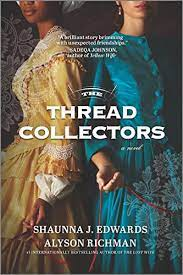
The Thread Collectors by Shaunna J Edwards and Alyson Richman

When Stella and William say a passionate farewell at the beginning of this story, they have no idea if they will ever reunite. William is an enslaved Black man in the South, escaping his master at the outset of the Civil War, and Stella is an equally indentured Black woman who technically is free but is “kept” by a White man for his “pleasure.” All William has is his flute and his magically musical ear, but this wins him a place by the side of his newfound friend, Jacob. Likewise, Jacob, a Jewish New Yorker, who has signed up on the side of the Union, with the dream of fighting to end slavery, has also bid goodbye to his true love, Lily. He also has no idea if he’ll be able to return to her, fearing the worst as he moves closer and closer to the front. All he can hope for is that her continued correspondence and her love for him will help him through his arduous fight.

This narrative was apparently based on true characters in the history of the two authors’ families. Each of them is writing about the marginalization and, particularly in the case of the Black men who fought for the Union, dehumanization, experienced by these soldiers. And how relevant is this story now? With the rise of antisemitism and racism that is rampant in this country – and worldwide – it is both tragically and unsurprisingly, unchanged. Both Jacob and William experience the feeling of being treated as less-than, socially, financially (William is paid less than his White counterparts in spite of doing their scut work), and in terms of supplies, food and healthcare. Moreover, I feel that many of us can, sadly, relate to the schism in Jacob’s family, as he finds that his brother sides with the South and defends the vile institution of slavery, while Jacob and Lily fight for abolition.

As a novel in itself, however, I feel it is just ok. While it tells an important story, and there are some gritty and heart-rending scenes, it is mostly on the predictable side and just a bit corny. A few coincidences are just too perfect and a few situations turn out just too well to believe.

On the whole, however, it is a worthy read and one can learn quite a bit about this slice of history, from a more insider, less glamorized perspective.

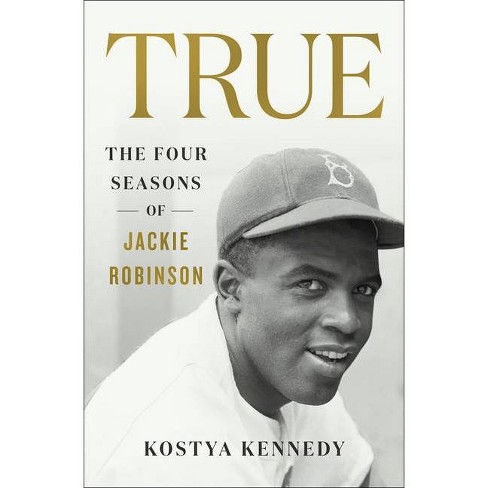
True: The Four Seasons of Jackie Robinson by Kostya Kennedy

Jackie Robinson broke barriers. He broke through barriers when he joined the Montreal Royals, and then he broke through even more dramatically in the US when he joined the all-White, Major Leagues, as a Brooklyn Dodger. With his unique batting stance, his gutsy base-stealing, and his overall agility and competitive exuberance, he was a shining light for his team and for anyone lucky enough to be in the stands to watch him play. And while he encountered innumerable incidents of racism, he always maintained a calm demeanor even as he spoke his mind plainly. Through his larger-than-life image of poise and strength of character, he and his wife, Rachel, became integral to the advancement of civil rights in our country.

In this colorful depiction of the life of Jackie Robinson, we are given an insider’s view of his life and his struggles, his victories and his pain. Kennedy, through extensive research and a clear understanding of the game, gives us not only detailed descriptions of pivotal games played by Robinson – helping us to feel almost as if we ourselves are sitting in the stands – but also how Robinson must have felt during those games. We are deeply disappointed and hurt alongside Robinson during tours in the South, as he eyes his fellow teammates remaining on their bus destined for their all-White luxurious hotels, when he has to get off the bus to stay at a Blacks-only hotel or private home. We feel the resentment he feels as he continues to see, year after year, no Black managers or team officials in spite of his continued advocacy for this. But we are also thrilled by his wins and inspired by his accomplishments.

What I loved about this biography of Jackie Robinson was the tribute given to his wife, Rachel. It seemed that Robinson himself gave her so much credit for his success – and that was evident here in this book. Theirs was a true love story; they seemed to be a genuine team in love and in life. While she was a homemaker for much of his baseball career, she was trained as a nurse and an educator, and she returned to working once their children were grown. Later, she also helped to forge the advocacy and fundraising he began, long after his death.

You definitely have to have an interest in baseball to get through this book, as there are many detailed descriptions of games, plays, and players. But if you do, you will also learn quite a bit about how baseball lived as a metaphor for many, particularly those in the 1940’s and 1950’s, in Jackie Robinson’s heyday, for some movement toward the advancement of civil rights in this country.

The Mitford Affair by Marie Benedict

Nancy Mitford is at a loss. She cannot fathom how her 2 younger sisters, Diana and Unity, have been so sucked into the not-so-underground fascist movement that is brewing among a segment of the British elite in their 1930’s lives in London. It is shocking, that Diana, in particular, once the literal belle of every ball can now be hanging on every word of her precious leader, M. Where will this lead? How far will they take these outlandish and extreme ideas? And will it drive a divide between the once very close sisters? As their story unfolds, so too does the dark history of this movement among the British just prior to the outbreak of World War II.

Based on the lives of a real family of sisters (and a brother) who were among the withering elite of Britain just prior to the outset of the second World War – and who were also, significantly, cousins of Winston Churchill – this fascinating historical fiction novel teaches us much about the existence of fascism in England at this time. The leader of the movement, M, is portrayed as an ego-ridden, single-minded, albeit charismatic speaker who is willing to use any means available to accomplish his goal -allying himself with the despicable likes of Mussolini and Hitler. Because he is so desperate for financial backing, he is manipulated into acceding even to denounce the Jews, whom he had not been against initially.

Parts of this novel were physically painful to read. Depictions of Hitler as charming and cultured went against every fiber of my being, having very personal connections to the destruction that he and his Nazi regime have wrought. But at the same time, I feel it is incumbent upon us to appreciate how history might have swung so easily in a different direction had strong and ethical individuals not stood up to him and his regime and done the right thing, fighting against tyranny and preventing further cruelty and harm that might have occurred.

And it is so relevant today. Do we not see folks voting for those who stand for tyranny just because they also threaten their wallets? Do we not see folks defending fascists who disguise themselves as ordinary Americans just because they might agree with them on issues that make them a bit uncomfortable? We are threatened just as deeply today as the Brits were during those dark hours before the war. We have to be alert for the signs – and reading books like this help us to stay on our toes.

Marie Benedict chooses fascinating people to write about- she has done so once again here. As difficult a read as this is, I would highly recommend it.


Demon Copperhead by Barbara Kingsolver

From the very moment of his birth in the narrow, rented trailer home where his teen mom went into an early labor, Damon already felt the stacking of the cards against him. His father already six feet under only six months prior, Damon learned early to try to hide his mom’s alcohol even as he hid from her poor choices in men. He also knew when to escape to the Peggots’, their kindly neighbors and grandparents of his ally, Maggot. But he lost his battle to protect his mom when “Stoner” moved in. While his mom believed this newest partner might provide stability, Damon saw that what he actually provided was constant tension and outright physical warfare. This was the beginning of a journey for Damon that led him through the nightmare of the foster care system, which would test him to the limits of both his weaknesses and his strengths.

Barbara Kingsolver has always been one of my favorite authors and, again, she has proved this justified. As she recreates the narrative of David Copperfield through the voice of a young, poor, Appalachian boy at the brink of the opioid crisis, she does so with authenticity, respect, a love of this part of the land and its people, and, yes, even humor. It is a hard story. Damon, or “Demon” as he is nicknamed, is abandoned into the foster care system and left to his own creative devices and survival instincts at an excruciatingly young age. We follow him through his minimal ups and prolonged downs and we see that he has, in spite of his circumstances, a kind heart and an artistic soul. We come to love him and see his failings as the failings of the system that has tried to eat him alive, rather than his own personal ones. We see how these failings have been built on generations of systemic exploitation and vulnerability.

Kingsolver, through this narrative, brings to light a few important messages. One is how the large mining magnates exploited so much of Appalachia without regard to the land or the people who lived there. They created dependence on the corporations for everything. The people were owned by these corporations, but not protected by them, as their health, education, and welfare were not at all the company’s concern. And once the land was stripped of its use, it was abandoned, as were the people who lived there, leaving only poverty in its wake.

So it is not shocking that Purdue Pharma sought to prey also on this vulnerable population, sending out its sales reps like missionaries to these communities who were middle and lower-middle class without great access to adequate health care. Few on the receiving end were insured, so much of their health care was in the form of emergency room or in-hospital care only. The providers there were sold the BS that Purdue Pharma was dishing out on pain management: that they had invented the miracle panacea for pain relief through Oxycontin and that it was, miraculously, non-addictive. Well, we know how that fable goes…

What I believe I loved most about this story, and what Kingsolver does so tenderly, is highlight the beauty of both this region and the folks who live there. She describes the landscapes: the steep waterfalls, the green mountains, the valleys and rocky streams -and the fauna and flora that thrive there. How even if poverty exists there, folks are able to farm a patch of land to grow vegetables, hunt for food, or knit themselves a few sweaters for the cold weather – and that they do so for each other in their close-knit communities – because there are still close-knit communities where everyone knows everyone else, and have known their parents and grandparents as well.

This is a uniquely gorgeous novel – one that should not be passed up. This is, without a doubt, a MUST READ!

(And I think it’s also time for me to revisit the original David Copperfield as well!)

Where We Came From by Oscar Cesares

Orly is feeling a bit resentful. His older brother gets to go to camp and his best friend gets to travel to Europe, while Orly finds himself being driven to his godmother’s home in her small town of Brownsville, TX for 3 long weeks. Not that he has anything against his godmother, Nina, but it isn’t exactly his first choice for a summer vacation plan. And for her part, Nina feels badly for the boy, having to spend his time with her, especially given her current situation. She would love to take him to places he’d enjoy, but on top of caring for her mother, which already is a burden, she has the added weight of the current secret hiding in the little house in her backyard, which she cannot share with him, nor with anyone else, for that matter. It’s just too dangerous. But how long can she really keep this secret from a curious, intelligent, and adolescent-brained boy?

This novel tackles the very complex and tragic issue of immigration over our shared border with Mexico, where on one side there are drug cartels openly wreaking havoc on their streets and on the other are either coyotes who prey on desperate refugees or border patrol agents hunting them down just to send them back all over again. Nina suddenly finds herself trapped in the middle, embroiled inadvertently in this dangerous, messy business. While trying to be compassionate and humane, she also must consider the safety and security of her own family as well – and it is complicated. Added to the mix a young boy whose life is on the line – it becomes that much more complex.

This is such an incredibly important book to bring to the attention of the world – and to bring down to a human level. These refugees are human beings, not numbers or statistics. No one leaves their home, their family, their communities, or those who share their native customs and celebrations unless they are utterly desperate and feel that their lives are truly threatened. We are morally obligated to show these individuals compassion and understanding – especially since most of us here in the US are descendants of those who were in similar circumstances at one time or another.

On the other hand, where I felt this book fell short was in bringing sufficient warmth, humor, and fire to these characters. We care but we are not dependent on what happens to them. While we understand that Orly is lonely, it does not become our loneliness. While we understand that he is grieving for his mother, it does not become our grief. The characters all remain one step outside, even as we want to know them more intimately. We are granted glimpses of Nina and her more glamorous past, but we still are not let inside, not really. And this keeping us at arm’s length keeps the story just that side of attachment to it.

This is a story I wanted to love, to be awakened by, to be energized by.  It is important, timely, and relevant. But I did not, was not –  not as I could have been.


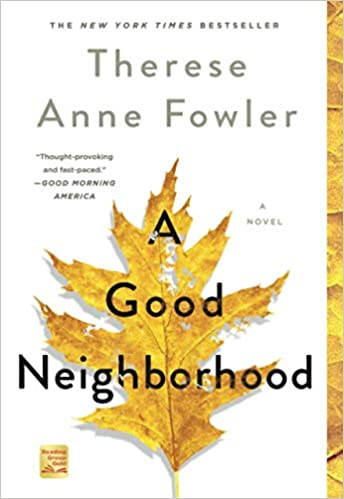
A Good Neighborhood by Therese Anne Fowler

Julia cannot believe how far she’s come. Considering where she started – a teen mom, struggling to keep a roof over her head – she’s feeling almost embarrassed at the size of her new home, with its pool and its technology that her husband Brad insisted on installing. When she meets her new neighbor, Valerie, she learns about the stately old tree whose roots they’ve apparently encroached upon with the building of their pool. She also meets Valerie’s son, Zay. And so does Julia’s daughter, Juniper. And here is where it all starts to get complicated…

I loved this book. Therese Anne Fowler confronts two common themes – climate change and racism, both obviously serious and challenging – but does so without preaching and with warmth, tenderness, and suspense. Creating characters that are entirely relatable, she wraps us up in their lives as if we are living right there in the neighborhood with them. She also uses an extraordinary narrative voice of “we” (presumably the neighborhood voice, perhaps even the book club members from early on in the book) which gives the reader the feeling that we are chatting over coffee with the neighbors about what is happening in our back yard. But we’re also inside the heads of the characters, so we understand their past and why they choose the actions than impact their futures. And just as if we’re watching a bad accident in slow motion, we can’t help yelling for them to not move forward, as we see them heading toward disaster. We are so invested in them because it feels like they really are our neighbors.

One concept that I’d not really heard much of prior to reading this was the “purity pledge” which this book brought to light. This is a vow of celibacy that girls (of course, mostly girls) take during a ceremony in their (often Southern Baptist) Christian church. It was most popular in the 1990’s and was apparently a source of great shame and struggle for so many. Yet another way to oppress women, deny their sexuality, and keep them under wraps, I suppose. (see article in NYT: https://www.nytimes.com/2021/04/06/us/abstinence-pledge-evangelicals.html)

A Good Neighborhood is a quick read, but a valuable one. I’d even go so far as to give it a MUST READ rating. I think the writing is excellent, I think the story is valuable, and the message is critical, especially in this moment.


Truths I Never Told You by Kelly Rimmer

Grace is on the brink and she doesn’t know where to turn. She knows she can’t be trusted with the care of her own children – she just can’t pull her mind out from under the dense blackness that has taken root there, and she knows that it’ll happen again if she has another child. It’s happened each time before. She just has nowhere to turn.

Decades later, Beth is grappling with her own frustration. She is clearly just stressed – her father is dying, she’s sleep deprived from a new baby, and she’s just not feeling up to going back to work yet. So why is everyone on her case, asking her what’s wrong? She’ll be fine. Won’t she?

The narrative between these two women brings us back and forth through the generations of this vulnerable, tender family and winds us through a beautiful story of love, heartbreak, and resilience.

The difference between these two women is also just one generation, and the epic difference between their generations is the passing of Roe v. Wade. One generation has the luxury of choice – the other lives without any control because they do not have that access.

I find myself writing this post on the morning that the Supreme Court of the US, staggeringly, has announced the repeal of Roe. I am still numb from this, even having tried to brace myself for what I knew was coming, although I still held out hope that some of the judges would come out on the just side of history. But no, the 6 conservative judges’ allegiance to their biased, misogynistic, utterly anti-life, hypocritical base was clearly too strong a tie.

Women will now return to the back alleys, the sepsis-inducing, life-threatening, desperate means of trying to gain control of their lives, which men put them at risk of, once again. Women will have to endure pregnancies they do not want, bear children they’re not ready to care for, and those children will likely live in conditions that are sub-par, to say the least, because those same Conservatives never vote for safeguards for these children once they are born. Hypocrisy at its very gravest.

Health care should be left to health care providers and their patients. Everyone else should stay out of it. Abortion and contraception is health care. Period.

This is a MUST READ at this time – I really wish the SCOTUS judges had read this novel before writing this decision.

The Other Americans by Laila Lalami

Nora cannot reconcile the guilt she feels that while she was relaxing over a celebratory glass of champagne with her roommate, her father was, at that very moment, tossed into the air by an as yet unidentified driver and killed. Nor could she believe, even through her profound grief, any possibility that this was a random accident. All she had to do was convince others to see things from her point of view as well. Would she be able to do this, without any witnesses, without anyone coming forward in her favor? Especially when even her family was willing to accept the party line…?

This is an excruciatingly timely story, as it addresses the deep-seated fear and resentment that so many white folks have toward any immigrant that has achieved any modicum of success. This “replacement” conspiracy theory once again rears its hideous head here.  Nora, a smart, talented, but dark-skinned, Muslim girl has been left out and “othered” most of her life, growing up in their desert town near Joshua Tree. Similarly, she’s observed her father, a hard-working immigrant from Casablanca, survive being targeted by racial incidents as well. While Nora has found solace in her music, she’s continued to experience micro-aggressions repeatedly and continues to struggle with navigating her way through. 

The author makes excellent use of a rotating narration, imbuing a distinctive and familiar voice to each character.  It feels as if we are sitting with the characters, hearing their side of the story as it is told perhaps in an interrogation room to the investigating officer.  We come to know each character deeply, understand their passions, and feel their pain. It works.

One character that is particularly endearing is Efrain, the singular witness. I will not give away details about him or his perspective, but he is portrayed beautifully and his struggle over coming forward is both understandable and tragic.

This is an engaging story with a powerful message – a worthy read!