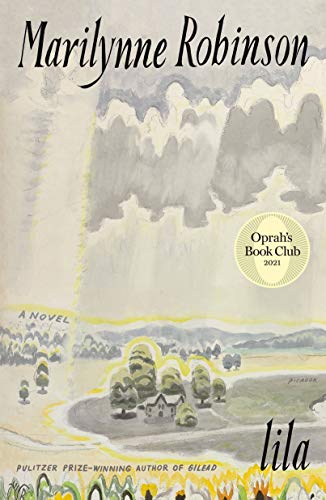
Lila is still trying to reconcile that she is here, now, in Gilead, married to the “old man,” John Ames, the respected preacher of this tiny village, especially given her meandering, even sordid past. If he knew the details, would he have so quickly and without judgement have been willing to baptize her? Would he still love her? Is she willing to risk telling him her secrets? Lila continues to hold herself close, even as she gradually learns about love and trust from the very gentle and kind John Ames.
This is a beautiful prequel to Gilead, very gently revealing the traumatic story of Lila’s youth. We gain insight into her quiet and independent nature, reading about the tender but precarious relationship she had with her beloved Doll, the woman who snatched her away from her house of origin and who raised her and protected her as a mother lioness would protect her young. We also are with Lila as she struggles to reconcile the ironies of organized religious precepts with the practical realities of the everyman’s day-to-day life.
Once again, Robinson’s writing is exquisite. She is able to quietly release the painful details of Lila’s life just as one might accidentally drop a pearl every now and then from a fine string. She creates images and characters that are imprinted in Lila’s mind, and so too, are imprinted in ours. We feel her loneliness and we are empathetic when Lila can only feel mean, because we are entirely with her in her lived experience. And the intermixing of philosophy and theology and storytelling is so subtle that we are contemplating it without even being aware.
If you’ve read Gilead, you must read Lila – it will only enhance your understanding of the story and of yourself.
Joan is an ICU attending at West Side Hospital in New York City. She is never happier than when she is reveling in the fast pace and the intensity of the Medical ICU, almost worshiping the machines that aid her in maintaining the lives of her patients. So why does everyone around her concern themselves with what else she might be doing? Why do her brother and his wife constantly ask her when she’s going to move to Greenwich and get married? Why does her neighbor, Mark, feel compelled to force-feed her a diet of current and past pop culture, as if there’s some form of test at the end? As Joan comes to terms with various changes around her, in her family, and in the world, she also learns to become more rooted and comfortable with who she happens to be.
This is, quite subtly, a coming of age story, although the heroine is already of age. While she is a fully accomplished adult, having achieved a brilliant career, those around her still are not satisfied and feel they need to impose upon her their own values of what a “full” life entails. Interestingly, I found myself, as the reader, getting sucked into the allure of what these others were suggesting for her. It initially feels innocent enough, particularly from her neighbor, Mark. It feels, at first, like generosity. But we see that what masquerades as kind very gradually reveals itself to be presumptuous and patronizing. Sometimes what others need and want, in fact, is to be left alone.
The writing here is superb. The story rumbles along in a way that is nakedly honest, much like the thought patterns of Joan herself. Her observations are often awkward and flat – and yet clearly betray her struggle over her identity and her relationships, both familial and social.
This is an engaging read, with a lot to say about how we interact with others who might see the world differently from how we might.
Born in Hyesan, North Korea, Hyeonseo Lee was raised, as all of her peers were, to believe that her country was the “Greatest Nation on Earth.” Indoctrinated from the time she was born to worship the leaders of her country above all else, she witnessed at the age of 7 what happened when one opposed the regime: public execution. But even while she felt the pressure to blend in and follow the party line, she noted that there were, in truth, stark differences in how people lived. While the communists sang about equality among the people, how their government provided for its people, Hyeonseo observed that a family’s social status determined just how much that government actually provided. In reality, it was far from an equal distribution. And while she was privileged to some degree, this privilege did not protect her family from political danger. In this memoir, she shares her utterly harrowing story of her years-long journey toward freedom.
If you’ve followed this blog, you will note that I have been reading quite a bit about various refugee experiences. All of them are impossibly harrowing, but none has read more like a suspense novel than this one. At every turn, this young woman and her family encountered unimaginable peril, always being on the verge of disaster and often experiencing heart-wrenching disappointment and suffering. They were constantly at the mercy of others, usually being preyed upon by corrupt officers and traffickers alike, rarely reaping the courageous generosity of others, even strangers. Most profoundly, once they finally did achieve freedom, they actually had to be taught that humans deserved fundamental human rights in order to understand how deeply their own had been violated.
The bravery and dedication to family demonstrated by this heroine is infinite. She is an inspiration to all of us, particularly in this moment when we are seeing so many fleeing their homes in search of safety. It reminds us that no one chooses to leave their home. One leaves only when there is no other choice.
I’d like to depart from my usual post and add a poem which I found deeply moving (shared with me by an inspirational leader for whom I am so grateful):
Home by Warsan Shire
no one leaves home unless home is the mouth of a shark you only run for the border when you see the whole city running as well
your neighbors running faster than you breath bloody in their throats the boy you went to school with who kissed you dizzy behind the old tin factory is holding a gun bigger than his body you only leave home when home won’t let you stay.
no one leaves home unless home chases you fire under feet hot blood in your belly it’s not something you ever thought of doing until the blade burnt threats into your neck and even then you carried the anthem under your breath only tearing up your passport in an airport toilet sobbing as each mouthful of paper made it clear that you wouldn’t be going back.
you have to understand, that no one puts their children in a boat unless the water is safer than the land no one burns their palms under trains beneath carriages no one spends days and nights in the stomach of a truck feeding on newspaper unless the miles travelled means something more than journey. no one crawls under fences no one wants to be beaten pitied
no one chooses refugee camps or strip searches where your body is left aching or prison, because prison is safer than a city of fire and one prison guard in the night is better than a truckload of men who look like your father no one could take it no one could stomach it no one skin would be tough enough
the go home blacks refugees dirty immigrants asylum seekers sucking our country dry niggers with their hands out they smell strange savage messed up their country and now they want to mess ours up how do the words the dirty looks roll off your backs maybe because the blow is softer than a limb torn off
or the words are more tender than fourteen men between your legs or the insults are easier to swallow than rubble than bone than your child’s body in pieces. i want to go home, but home is the mouth of a shark home is the barrel of the gun and no one would leave home unless home chased you to the shore unless home told you to quicken your legs leave your clothes behind crawl through the desert wade through the oceans drown save be hunger beg forget pride your survival is more important
no one leaves home until home is a sweaty voice in your ear saying — leave, run away from me now i dont know what i’ve become but i know that anywhere is safer than here
This fantastical journey sets out as we meet Ben, shattered by recent events in his life – a nasty divorce and the painful death of his mother – who is encouraged by his twin sister, Sara, to attend a singles event at an art museum. As it happens, he stumbles upon a Chagall painting there that looks very familiar – so familiar that he is driven to do something impulsive, something that will have lasting implications for both him and his sister.
This story is told in layer upon whimsical layer, with narration as chromatic and surreal as a Chagall painting. The author weaves together the family stories of Ben and Sara’s parents, stories written by their mother, stories about Chagall and an author colleague Der Nister, and dream sequences, sometimes blurring what is real and what is fantasy. The prose is poetic and vivid, creating images that shower into the imagination and that will likely stay with the reader long after the last page is turned.
There is also biblical referencing that reinforces a strong philosophical message here. Without giving too much away, there are many references to meaningful value of life and making the most of our time here on Earth. Sara’s mother tells her, “Everything counts. Don’t ever let anyone tell you that you’re just rehearsing for your life.” We see different attitudes toward life between Ben and his sister, even between Chagall and his colleague, Der Nister. Some who live life while others who watch others live life.
There is much to keep track of here, as the story winds through its circular path. It can sometimes become challenging, even. Nevertheless, it is definitely worth the challenge, worth the swelling of your imagination, this beautiful tale. Like walking into a painting yourself…
On their route back to their hotel after a Sunday service at the African Free Church in Charleston, SC in the year 1859, Mother, Mary and Georgy Woolsey come upon a wagon transporting children – babies – to be sold at auction that afternoon. Horrified, they stay to observe what they’d never seen in their home town of New York City, and although they could not mitigate the cruelty of that moment, Mother slips her business card to their mother, hoping to give her a place of future refuge, a focus for hope. Georgy takes this a step further, by signing up to train and work as a nurse, bravely and passionately caring for soldiers who fight for the freedom of these enslaved individuals. Georgy’s story ultimately intertwines with the stories of both Jemma, an enslaved young woman on the Peeler Plantation in Maryland, and Anne-May, the young plantation owner. As their stories unfold, so do those of the battles of the Civil War, the atrocities of slavery, the profiteering of spies, and the ultimate path to justice and freedom.
This is an intricately woven, thoroughly researched, historical fiction novel based on the actual, courageous lives of the Woolsey women of Connecticut and New York City. Georgy’s character is real, and while some of her exploits are fiction, much of what is written is based upon her actual life experience. She is a strong-willed and fiercely independent character, and is not caught up in the superficial exploits of her wealthy cohorts. While many look down at her for pursuing a nursing career, and while the male nurses and many doctors around her treat her and her female colleagues with brutal disgust, she plods along and doles out the outstanding, compassionate care she is trained to deliver.
On the other hand, Jemma and Anne-May are not real people, but rather, created as representative characters that are typical of their era. Jemma, a young and strong-willed woman, born into enslavement and treated harshly most of her life, carries trauma both physical and psychological with stolid forbearance. She keeps fighting for what she believes in, but she is also realistic and understands more than most man’s capacity for evil. And Anne-May happens to be one of the ones to show her how deeply this capacity runs.
One of the most moving parts, for me, was a scene in which Jemma finds herself in the warm embrace of the Woolsey sisters. Finally finding a moment of respite from her terrifying world, she is given a chance to experience freedom in a way she’s never felt before. Sadly, she finds herself under a new kind of oppression. While there is good intention and care, she is still being told what to read, what to think and what to do. In a dramatic moment, she blurts out in anger, asking to be left alone to decide these things for herself. As often happens, one of the sisters takes offense, because of her well-intentioned motives, not realizing that her actions and their repercussions are independent of her intention. Only Georgy is able to take in what she is saying and their bond tightens because of it. This is a powerful moment that resonates still today.
In this gorgeous novel you will find breathless suspense, moments of deep sorrow, and dramatic scenes of triumph, and each of the characters will bring you on a journey you will love being on with them. Martha Hall Kelly has absolutely done it again, with this third in the series about this awe-inspiring family and has created another MUST READ for us all. These are truly gifts she has bestowed on us – and I for one am grateful.
Although she’s been told she’s worth nothing her whole life, Elsa still dreams of a world in which she might accomplish something worthwhile. Being 25 and unmarried in the early 1930’s is a pretty clear indication that chances are slim that you will be leaving your family home at all. No, you’ll likely be under the thumb of your overbearing, critical mother and father your whole life. Unless you take action. Unless you do something drastic – like maybe buy that bolt of bold, red silk and sew yourself that beautiful, lavish dress and just sneak out for that night on the town and pretend you’re like everyone else– to hell with what they say. Be brave, her doting grandfather used to say to her. Well, she just might. Little does Elsa know that being brave will have to carry her through all of what comes thereafter, as she takes each next step, wanted or not.
In The Four Winds, Kristin Hannah has written what will inevitably come to be known as a great American novel, a sort of Grapes of Wrath narrated through the voice of a woman. We are lured inside the head and the heart of our heroine, Elsa, a modest, resourceful, and hard-working woman, bitterly rejected by her own family. She easily earns our sympathy, as she gradually gains her own strength, visualizing her own purpose. We feel love when she is finally loved and we shed tears when she is hurt, and we applaud her as she overcomes one arduous obstacle after another.
This is also a story of a dark era in our history. The Dust Bowl crisis during the Great Depression was a tragic consequence of the prolonged drought that occurred during the 1930’s, and layered onto the economic crisis of the Depression, it could not have come at a worse time. Scorched farmlands bankrupted thousands, and, lured by advertisements for jobs, too many fled west and found only steeper poverty and absent resources. The narrative starkly highlights the failure of our country to adequately provide for those who were left with nothing. This left those who were more fortunate, empowered by their vigilante groups, to demonstrate only anger and hatred toward these folks who were starving for work, starving to have the opportunity to help themselves.
I love that the women here are strong characters. Elsa grows into a strong character as she comes to know herself. Her daughter, Loreda, is born strong – rebellious, with a righteous anger that is sometimes misdirected but always idealistic. And there is Elsa’s mother-in-law, Rose, with her quieter strength – a woman who is fiercely loyal, uncomplaining, and who has the softest heart and is present when it matters. These are beautiful characters who will likely stay with you long after you finish turning the pages of this novel.
This story will singe a hole in your heart, but it will also fill it with admiration for the souls who fought for others, to raise up the unfortunate. It also reminds us how frequently history does repeat itself and how important it is to learn from the past.
Tiny has always been the perfect everything – the perfect daughter, the perfect sister, and now she’s expected to be the perfect wife as well. And Frank requires the perfect wife – doesn’t he? – if he is to be elected to congress, as he should be. But what about Tiny? What about what she really wants? Does it matter? Should she make it matter?
Beatriz Williams never fails to deliver the most lovable characters, impeccable writing packed with humor and expectation, and a twist that assures that she is always one step ahead of you. You will find yourself giggling at her sarcastic phrasing – so often brilliant – even in those thrilling moments when you cannot stop turning the pages. And you will relish in that delicious tension of not being able to read quickly enough to get to know what happens and not being able to read slowly enough to make the joy of it last longer.
And please don’t mistake this for fluff. There are subtle but important issues here. Williams intentionally elevates strong female protagonists, and Tiny is yet another. She struggles here for independence, and in the mid-1960’s, this is no easy mission. It wasn’t done, not in the family she married into, not in the social sphere in which she circulated. Women were only just beginning to break out of the 1950’s housewife-who-always-had-dinner-on-the-table-and-a-martini-waiting-for-her-husband-at-the-end-of-his-workday stereotype. Even as Tiny frets over how she cares too much what others think of her, she realizes that she must depart from what is expected of her in order to preserve her true self.
This may not be a “MUST READ” but you really must read this – it is pure delight!
In this tender memoir, Trevor Noah shares his experience growing up during the final edge of apartheid in South Africa. Through vividly narrated vignettes, we learn about his complicated relationship with his mother, who is fiercely devoted to him and yet is independent, stubborn and vulnerable. We learn of his early struggles to find himself, and how he must battle against the vicious cycle of poverty that apartheid has inflicted upon his people.
It was suggested to me to listen to the audio version of this book – and this was excellent advice. Hearing Trevor Noah narrate his own story, in his own beautiful, South African accent and fluidly modulating to his family and friends’ voices and accents, is just a gift to yourself.
Noah is a brilliant storyteller. He shares his experiences with such warmth and humor, as if he is sitting with you in your living room, over a cup of your favorite hot tea – but as if he’s sharing his deepest, darkest memories, only with you. He describes in colorful detail some of the most outrageous adventures and unbelievable experiences. But even as he shares his joy and his pain, it is as if he is flickering a smile at you, as if to say, we can still laugh, even as we hurt. This is how we cope.
You will be engrossed and amazed — you will gasp and you will laugh out loud. Don’t just read this one – listen to it!
It’s a “MUST READ” but more than that, it’s a “MUST LISTEN!”
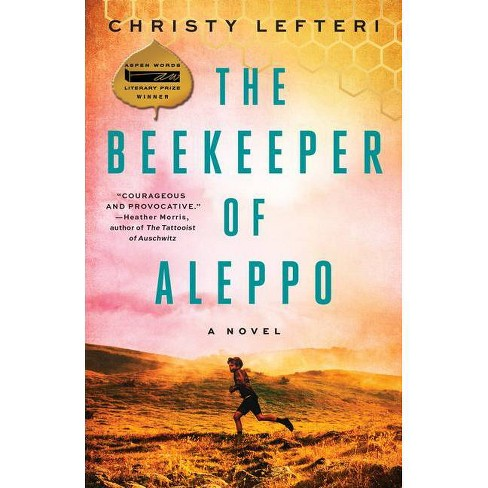
Nuri and his wife, Afra, have survived the arduous trek from Aleppo to the UK, and while they are awaiting their asylum application interview, they are staying in a B & B with immigrants with similarly devastating pasts. This waiting is not easy. Nuri is plagued by flashbacks of their escape from Syria, the trauma and losses they’ve experienced during the war there, and the anxiety about what lies ahead. But because he is seeing this trauma through his own eyes, he is finding it hard to connect with Afra, who is seeing it through her own. The question is whether or not they will find their way back to the family they know they once were.
This is not my first exposure to the refugee experience; though this may be one of the most poignant. I believe what contributes greatly to this is the sensorial nature of the author’s descriptions. We inhale Afra’s rose perfume as Nuri does,. We hear the buzzing of the hives tended to by Nuri and his cousin, Moustafa. And we can envision the stark colors of the drawings created by Afra, even when she cannot. And since we are right there in the sensory experience, we are also with them in their fear, their vulnerability, not knowing whom to trust, wondering where their next meal or shelter will come from or how they will get to the next step of their journey. We feel it in our bones.
In this depiction, we also see the worst of people and the best, as we do in most crises. We see the vultures who prey on the vulnerable, those who profit from those who are destitute and desperate and the corrupt underworld that feed off of this humanitarian nightmare. As Nuri gains the trust of others in his travels, he learns their stories and sees that his situation is not even the worst possible, and he feels deeply, especially for the plight of the many babies and young children refugees. On the other hand, he also encounters many who are kind, those who give food and clothing to the passing refugees, and those who do show compassion and support them in their journey.
I think this is an important read with an understated yet powerful impact that will linger with you long after you turn the last page.
It’s been 2 years since Lexie has heard from her sister, Annie, but she knows that her call can only harbor some tumultuous disaster. Chaos has always followed Annie, ever since their messy youth, and Lexie has always been there to be the adult in the room and to pick up the pieces for her. But this call… this blow may be more than even Lexie may be able to patch back together for her. This may be the one time that Annie may have to rise to the occasion and solve it for herself.
From the first page, we are locked in. Rimmer’s writing is fluid and compassionate although we can sometimes guess where the plot will take us, we are still so fond of these endearing characters that we feel compelled to keep turning the pages and follow them through their painful and hard-earned wins and losses. As the narrative bounces back and forth between Lexie’s current day experience and Annie’s journal entries, we are given a window into both what is happening now and what their explosive past has been like for each of them. And we cannot help but become emotional as this tender and tragic and beautiful story unfolds.
There is so much to unpack here, but I will try not to give too much away as I try to do so. One major theme is the injustice of our patriarchal laws around maternal-child welfare. Our laws that protect the unborn are geared to protect children, yes, but they completely ignore the woman who is hosting the growth of that unborn not-yet-person – and this is obvious throughout this story. This problem with our judicial system is magnified if that woman/host is afflicted with any kind of addiction. She is blamed for having a disease that is out of her control. We do not take away babies from mothers who do not care for their out-of-control gestational diabetes- nor should we! – but we imprison mothers who use illicit substances while pregnant. These mothers all have medical issues that need to be addressed, but because one is considered “bad” and one is considered “medical” we place a moral judgement upon one vs the other. As is pointed out in the novel, we should be spending the money that we use to imprison these women on evidence-based treatment for these mothers, parenting support when the babies are born and on early childhood interventions, if we REALLY want to benefit these children. Children generally do best when they are with their families. This is highlighted here so very starkly and appropriately.
Families are complicated and messy and Rimmer gets this so right. You cannot help but have your heart melt from this one.





 kindread spirits